Financial services may run on data, but for early-stage fintech startups, accessing high-quality datasets has long been one of the biggest barriers to innovation.
Building a strong product is only part of the challenge. Founders also need access to the data that allows them to validate ideas, train models, test infrastructure, and demonstrate value before they ever reach enterprise customers. Yet for many startups, premium datasets remain out of reach because of lengthy procurement processes, high licensing costs, and limited relationships with established data providers.
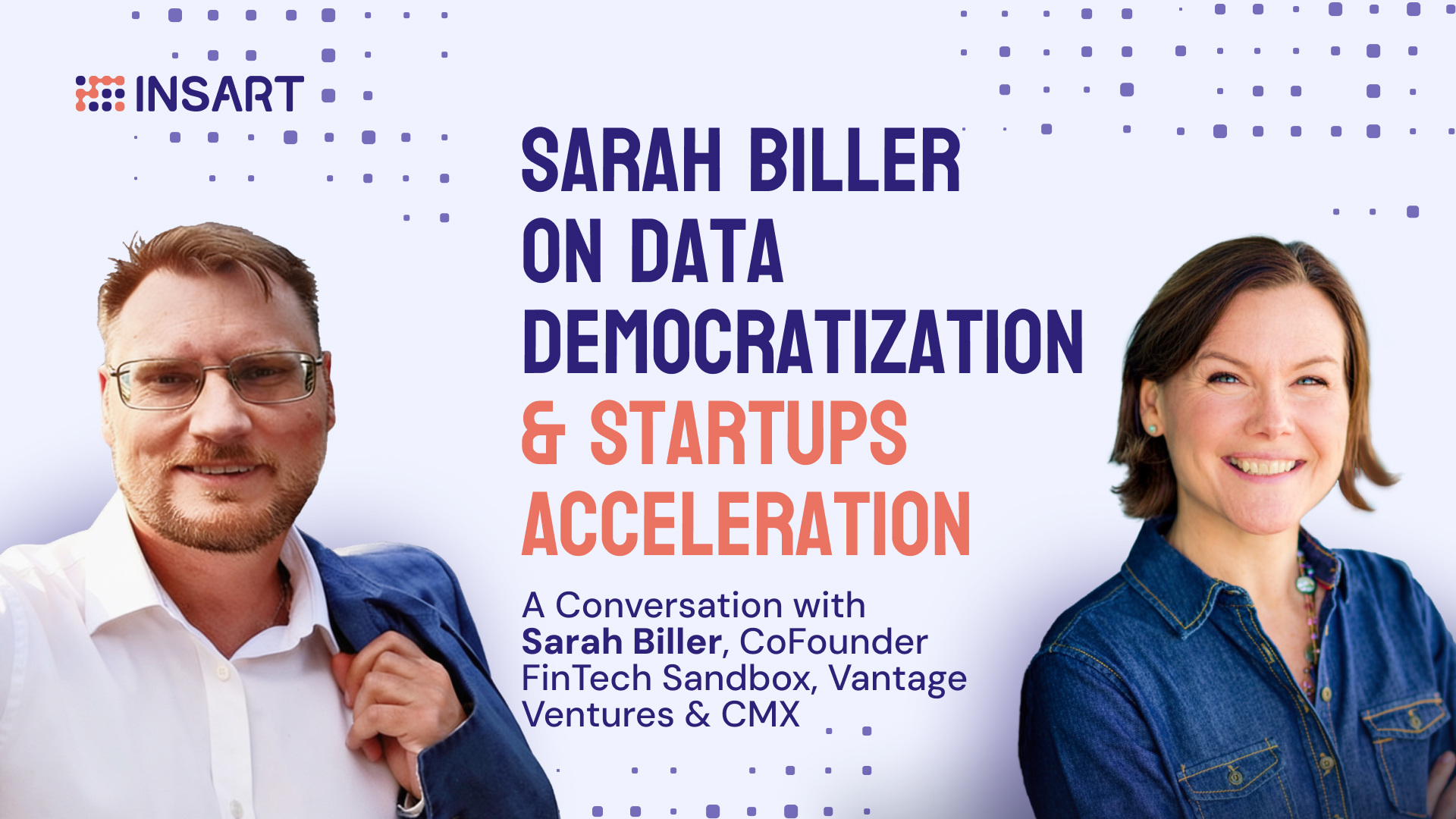
In the latest episode of the Guts, Grit & Fintech Podcast, Vasyl Soloshchuk, Founder and CEO of INSART, sat down with Sarah Biller, Co-Founder of Fintech Sandbox, to discuss how open access to financial data is helping reshape fintech innovation. Since launching the nonprofit in 2014, Fintech Sandbox has grown into a global ecosystem supporting more than 400 startups across 19 countries, connecting founders with over 40 leading data providers while fostering collaboration between entrepreneurs, financial institutions, investors, regulators, and academia. Their conversation explores why ecosystem thinking creates value for everyone involved, how AI is transforming the role of data, and why collaboration may be the industry’s greatest competitive advantage.
Building Fintech Sandbox
Vasyl:
For listeners who are new to Fintech Sandbox, what is the organization, and what problem were you trying to solve when you founded it in 2014?
Sarah:
Fintech Sandbox really began with a problem I experienced myself. Following the credit crisis, there was a growing belief that technology could solve many of the structural challenges facing financial services. At the time, I was building a predictive analytics platform for institutional debt investors to identify non-financial factors contributing to credit risk. I had venture funding, an experienced team, and a clear vision, but I couldn’t access the data I needed to prove the idea.
That experience led my co-founder, David Jegen, and me to ask a question: What if we could put high-quality data into the hands of entrepreneurs trying to build the future of financial services?
We realized the biggest barriers weren’t only the cost of premium datasets. Procurement itself was slow and difficult, making it incredibly hard for early-stage companies to get started. We created Fintech Sandbox as a nonprofit because we wanted to remain independent of the commercial relationship between startups and data providers. Our goal was to remove one of the industry’s biggest obstacles to innovation. Today, entrepreneurs receive six months of free access to premium datasets from more than 40 global data providers. Since launching, we’ve supported over 400 startups across 19 countries, many of which have raised funding, been acquired, or introduced new financial services for previously underserved communities.
Building an Ecosystem Around Data
Vasyl:
You’ve built an ecosystem where data providers, financial institutions, investors, and startups all collaborate. How did you convince large organizations to participate?
Sarah:
It starts with a simple belief that a rising tide lifts all ships. Our responsibility is to make sure founders are ready to use the data productively before they’re introduced to our partners. That creates confidence for everyone involved. But startups are only one part of the ecosystem. Large financial institutions want visibility into emerging technologies and future talent. Investors are looking for the next generation of companies. Regulators and academics are interested in understanding how financial services is evolving.
Our role is to bring those groups together. Through initiatives like Boston Fintech Week and our global Demo Days, we showcase what founders are building while creating opportunities for introductions, partnerships, and investment. We intentionally stay out of the commercial relationship. If startups create value with a data provider’s products, those business relationships develop naturally. Our job is simply to create the conditions that allow innovation to happen.
Why Broad Access to Data Matters
Vasyl:
Some argue that giving startups access to valuable financial data creates competitive risks for incumbents. Why do you believe broad access remains essential for the future of the industry?
Sarah:
It’s a question we’ve asked ourselves repeatedly over the past decade. When we started Fintech Sandbox, the challenge was simply getting access to structured financial data. But as generative AI emerged, the conversation changed dramatically. Today we’re dealing with models trained on billions of data points, creating entirely new possibilities—and entirely new questions.
The importance of data hasn’t diminished. If anything, it’s become even more critical. Financial services continues to evolve rapidly, whether through digital assets, new payment systems, or financial capabilities being embedded into industries like healthcare, energy, and transportation. Fintech is no longer confined to a single industry vertical—it has become horizontal, touching almost every sector of the economy. If entrepreneurs are going to continue driving that innovation, they need access to increasingly diverse datasets. The opportunity today is much bigger than it was ten years ago, and our thinking about data needs to evolve alongside it.
How AI Is Changing the Data Landscape
Vasyl:
AI is reshaping how organizations use data. Do you think it will increase demand for high-quality datasets, and how is Fintech Sandbox adapting?
Sarah:
AI is creating enormous demand for data, but it’s also introducing new complexity. One of the biggest debates today is the balance between authentic datasets and synthetic data. Synthetic data can be statistically sound and incredibly useful, but it’s still different from the original information. The industry is only beginning to understand where each approach is most appropriate.
Privacy presents another challenge. Large language models are pushing long-standing assumptions about how personal data should be used, particularly in financial services where trust has always been fundamental. At the same time, organizations are expected to process not just terabytes, but petabytes of information. AI is transforming what’s possible—but it’s also forcing us to ask entirely new questions about governance, privacy, and responsible data use.
I don’t think anyone has all the answers yet. What’s most important is that the industry comes together to ask better questions. In many ways, we all need to become better prompt engineers—not just when working with AI, but when thinking about how data should be created, shared, and applied in a world that’s changing faster than ever.
Measuring the Success of an Ecosystem
Vasyl:
If you had to choose one KPI that tells you your ecosystem is working, what would it be?
Sarah:
It isn’t funding raised or companies created, although we’re proud of those outcomes. The KPI I’m most proud of is when one generation of entrepreneurs becomes an enabler for the next. We’ve seen founders build successful businesses using Fintech Sandbox, grow to meaningful scale, and then realize the datasets generated by their own companies could help future entrepreneurs solve new problems.
One example is Seven Chord, whose pricing platform for fixed-income investors now contributes data that other founders can use to build their own products. We saw something similar with Pedal. As the company grew, it launched Prism Data, allowing other entrepreneurs to use anonymized financial insights to better serve underserved communities. To me, that’s the strongest signal that an ecosystem is working.
Final Thoughts
Over the past decade, Fintech Sandbox has grown far beyond its original mission of improving access to financial data. It has become an example of how ecosystem thinking can accelerate innovation across an entire industry. As Sarah Biller explains, supporting entrepreneurs is about creating trusted relationships between founders, data providers, financial institutions, investors, regulators, and academia, relationships that allow ideas to move from experimentation to real-world impact.
As AI reshapes financial services and demand for high-quality data continues to grow, the questions surrounding access, privacy, and governance will only become more important. Yet one principle remains constant: meaningful innovation rarely happens in isolation. When the industry shares knowledge, resources, and opportunity, the entire ecosystem becomes stronger, and today’s founders are better equipped to build the next generation of financial services.