![[SIGNALS] Interview with Bettina Rubek Slater](https://insart.com/wp-content/uploads/2026/06/signals-interview-with-bettina-rubek-slater.png "The Fortnight That Could Save Your Startup: Interview with Bettina Slater")

Bettina has spent 25 years watching smart founders execute themselves into corners. Now, with SuperRise, she is building the platform that gives every founder access to the senior strategic thinking they could never afford right when they need it.
The Same Conversation, Twenty-Five Years Running
There is a particular kind of expensive mistake that Bettina Rubek Slater, the founder of the SuperRise, has watched founders make, again and again, across a career that spans two and a half decades in technology and marketing. It is not a failure of intelligence, or effort, or even ambition. It is a failure of sequence.
The pattern is almost always the same. A capable founder, under pressure to show momentum, skips the hard thinking and goes straight to building. Six months later, they are rebuilding. The lost time, the wasted capital, the repositioning exercise that should never have been necessary – all of it traceable back to a fortnight of strategic clarity that never happened.
She has seen it many tens of times. That recurring observation is what eventually became SuperRise, an agentic AI platform designed to make structured strategic thinking accessible to every early-stage founder.
“Founders and leadership teams at all business stages skip the strategic work because it feels slow,” she says, “then spend six months rebuilding what a fortnight of clarity would have given them.”
The second pattern Bettina identified was about access. Senior strategic expertise – a CMO who has scaled a B2B business, a Sales advisor who has built a pipeline from scratch, a COO who has designed operating systems under pressure – is expensive. It is fragmented across consultants who each see one slice, advisors who appear only for board meetings, and agencies that produce strategy documents nobody reads. A founder earning their first revenue cannot afford any of it.
“So they guess. And guessing hard is the most expensive thing a founder can do,” Bettina says.
The third pattern is perhaps the most insidious. Even when good advice arrives, it does not persist. The workshop ends. The deck closes. Three weeks later, the founder is improvising again, with no memory of the agreed direction, no record of the reasoning, and no system to apply it consistently.
SuperRise was built, Bettina says, because “I wanted to help every founder and leader I meet but I simply don’t have enough time to help them all.”
Why Smart People Execute Too Soon
Ask Bettina why intelligent, capable founders consistently skip the strategic work, and she does not reach for a comfortable answer. She gives two: one structural, one psychological.
The structural explanation is familiar to anyone who has spent time in startup culture. Founders are pattern-matched to build, ship, iterate. The ecosystem rewards visible motion. Strategic clarity is invisible work as it produces no demo, no commit, no LinkedIn post.
The psychological explanation is harder to sit with.
“Sitting with strategic ambiguity is psychologically harder than building. Building gives you a dopamine hit. Strategy forces you to confront how little you actually know about your customers, your market, and your business model,” Bettina shares.
“Most, even very smart, founders avoid that confrontation by staying busy. But hustle without clarity risks becoming an expensive motion later on.”
There is, she notes, a particular emotional dynamic at play for founders who have conflated their identity with their company. When the company is the founder, slowing down feels like personal failure. Strategy work that exposes flawed assumptions feels like an indictment of the founder, not the plan. And a third driver: the fear of strategic conversations revealing how much is still unknown. Building gives the illusion of certainty. Strategy removes it.
“Most premature execution is a defence mechanism against the discomfort of not yet knowing. None of this is irrational. It is just expensive.”
The Sequence
The SuperRise methodology is built around a proposition that strategy should go first, execution second, communication third. The sequence, Bettina argues, is not a matter of preference. Reversing it is, in her experience, what has the potential to kill companies.
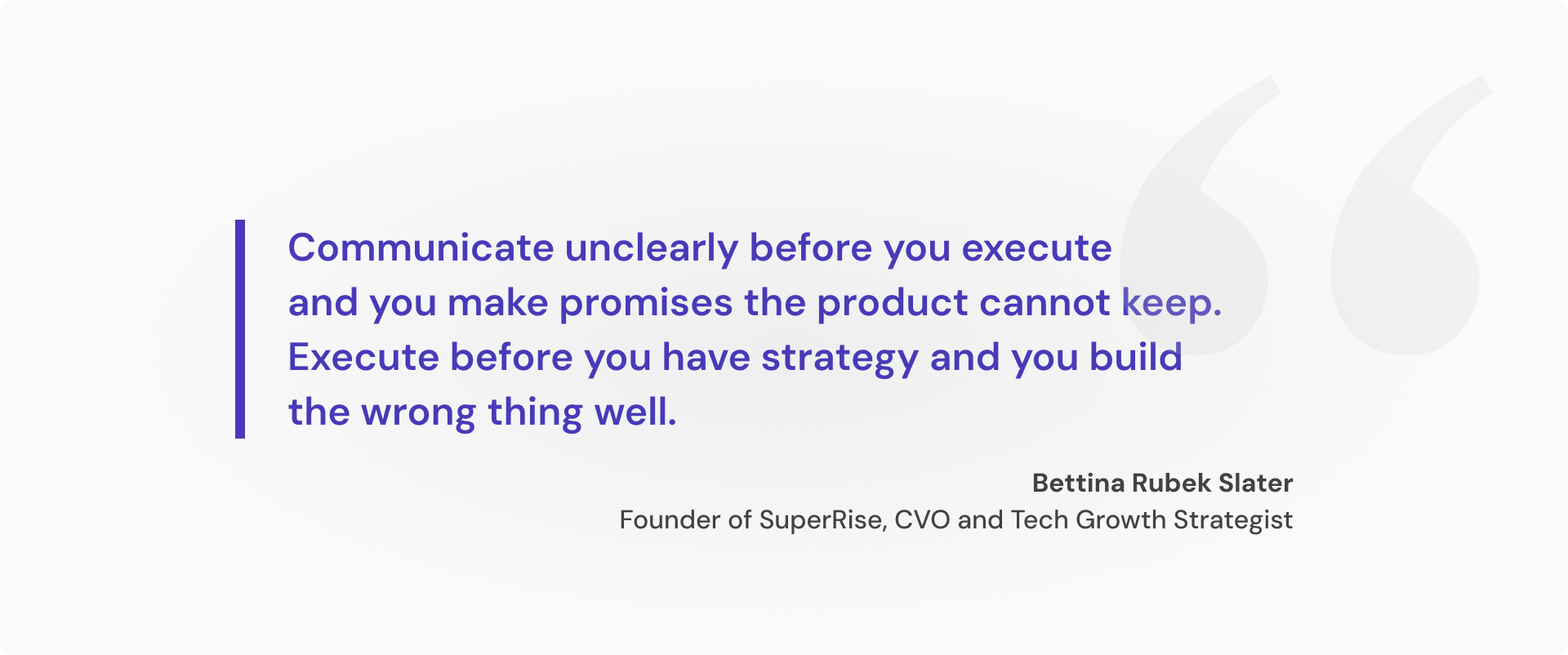
“Communicate unclearly before you execute and you make promises the product cannot keep. Execute before you have strategy and you build the wrong thing well.”
Context informs strategy. Strategy tells execution what to build. Execution gives communication something real to say to the right audience. When founders invert this order, usually because a competitor launches or a deadline looms, they get a polished message attached to a confused audience, and a product built on a guess.
“That is how good companies stall their GTM and traction in plain sight,” says Bettina.
The practical intervention is what she calls separating the two clocks. There is a momentum clock – visible activity, shipping, posting, meeting – and a strategic clock, which moves on a weekly or fortnightly cadence in deliberate, protected sessions. Founders conflate the two and interpret any time spent on strategy as time lost on momentum. The reframe is that strategic time is what makes momentum compound rather than dissipate.
“The founders I work with who slow down properly ship faster six months later. The ones who refuse are still ringing me at midnight in month nine asking why nothing is landing.”
The AI Question
In the current discourse about artificial intelligence and the future of work, there are two positions that tend to dominate: AI as existential threat to human judgment, and AI as the answer to every productivity problem. Bettina holds neither.
“AI is part of infrastructure these days. Just like Cloud and many other development tools are. It is part of the execution layer. Not the strategic brain and not the moat with which to build a proposition.”
The defensible part of SuperRise, Bettina argues – and of any company seriously building with AI – is the knowledge base on which the agentic platform executes. The AI is excellent at applying frameworks, generating options at speed, and producing the artefacts founders are judged on. It is poor at deciding which problem is worth solving, reading a customer’s actual pain rather than their stated pain, and knowing when to break the framework. And more importantly, meeting face-to-face to form human relationships is of course, off the table.
The line Bettina draws: anything with a known structure, AI handles. Anything that requires deciding what matters, the founder owns. Founders and leaders are, in her framing, humans in the loop – and will continue to be so for the foreseeable future.
The danger she identifies is not AI replacing judgment. It is founders outsourcing judgment because the output looks competent. “A polished AI-generated GTM plan that targets the wrong customer is more dangerous than no plan at all, because it carries the confidence of a real, well thought-through plan. That is the trap to avoid.”
Positioning, Visibility, and the Compounding Logic
Bettina draws a sharp distinction between messaging and positioning – one that most early-stage founders find uncomfortable the first time they hear it.
“Messaging is what you say. Positioning is the space you occupy in the customer’s mind relative to the alternatives.”
Good messaging without positioning is a well-written sentence that does not change anyone’s decision. Strong positioning forces a choice, not a comparison. It tells the customer who you are not for, what you are replacing, and why the existing alternatives are wrong for them. She offers a diagnostic: if your competitor could swap their logo onto your homepage and the page still works, you do not have differentiated positioning. You have decoration with confidence issues.
Bettina cites McKinsey research showing that companies with clearly articulated positioning outperform peers by up to 20% in revenue growth, and notes that the gap is structural, not aesthetic.
On founder visibility, particularly on platforms like LinkedIn, her view is equally direct. The volume of generic, forgettable content has exploded as the cost of producing it has collapsed. The signal that breaks through is a specific human point of view, grounded in things only that founder has seen.
“The trap is using AI to sound, look and read like everyone else. You drown in a sea of other content. The opportunity is using it to amplify what only you can say.”
Her practical recommendation: publish less, but with sharper and deliberately polarising opinions drawn from actual operating experience, consistently enough that the market knows where to find you. LinkedIn rewards founders who sound like themselves, not founders who sound like everyone else.
The same compounding logic applies to growth. A spike (a launch post, a viral moment, a press hit) decays within a week. Compounding communication is the same point of view, repeated, refined, and evidenced across months until the market starts associating you with a category.
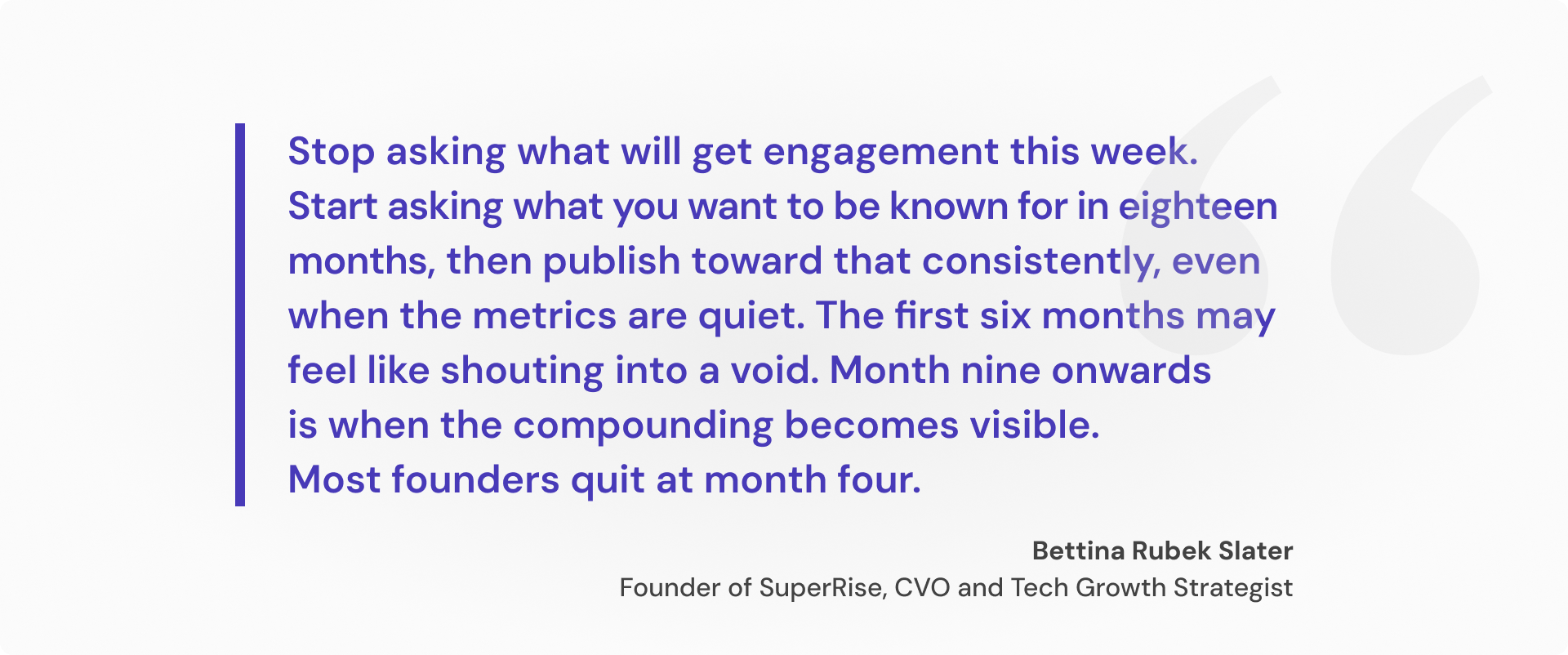
“Stop asking what will get engagement this week. Start asking what you want to be known for in eighteen months, then publish toward that consistently, even when the metrics are quiet. The first six months may feel like shouting into a void. Month nine onwards is when the compounding becomes visible. Most founders quit at month four.”
She adds, with characteristic honesty: “I say this knowing that we’re all guilty of not doing enough and consistently here. Myself included!”
What Genuine Foundations Look Like
When Bettina assesses whether a startup has real strategic foundations or merely polished presentation, she looks for three signals.
The first: “the founder can explain in plain language who they are not for, and they do not flinch when they say it. Many founders cannot do this. They want everyone to be a customer.”
The second: “the financial model and the pitch deck reconcile to the same numbers, with the same assumptions, on the same dates. Most pre-seed decks fail this test. Pipeline gets conflated with ARR. Forecasts float free from buyer reality.”
The third: “when you ask a hard question about the business model or the competitive landscape, the answer is specific and lived, not abstract. Polished presentation breaks down on the third question. Strategic foundations get sharper under pressure.”
The credibility-before-scale principle follows from the same logic. Five paying customers before a paid acquisition campaign. A published case study before three pitch decks. A chairman or non-executive director whose name investors recognise before the cap table is opened. Credibility is what makes scale cheap. Without it, every channel costs more, every conversation starts colder, and every claim needs more proof.
“Most founders try to scale credibility through volume. It compounds the other way around.”
Disciplined Ambition
There is a phrase Bettina uses that tends to stop founders mid-sentence when they first hear it: disciplined ambition. It is, she explains, a specific quality, and not the same thing as ambition.
“Ambition without discipline is delusion in expensive clothing.”
Disciplined ambition is “a founder who can articulate a ten-year outcome and the specific thing they are doing this quarter to move toward it, and who can also tell you what they are deliberately not doing.”
The distinction matters because most founders confuse ambition with optionality. They want to keep every door open. Disciplined ambition closes doors on purpose. The willingness to say no to good opportunities that do not compound toward the thesis is, in her view, a marker of genuine strategic maturity.
The Reckoning Already in Progress
Looking five years ahead, Bettina identifies three things she believes the startup ecosystem of the 2020s will eventually recognise it got wrong.
The first is the over-reliance on AI-generated everything. “Founders who built businesses on generic AI output will find their differentiation has evaporated by 2030.” AI is part of pervasive systems architecture and infrastructure. That does not make it a source of competitive advantage.
The second is the conflation of fundraising with progress. “A decade of cheap capital trained a generation of founders to treat raises as milestones rather than means. That mindset is already breaking.” Bettina points to the well-documented pattern of founders who took too much institutional investment too early and exited with very little reward.
The third is the neglect of unit economics in pursuit of growth narratives. The founders who survive the next five years will be those who took customers seriously before they took capital. “The ones that made sure they got to profitable PMF, early.”
What SuperRise Is Trying to Do
The metric Bettina cares about most for SuperRise is not revenue, or growth, or market share. It is the survival rate of companies who used the system through their first three years, measured against a comparable cohort who did not.
“If we move that number by ten percentage points, we have changed the economics of the early-stage ecosystem, and perhaps unlocked some of the dry powder that is currently not deployed in the European private investment ecosystem. That is the work.”
The founders who get the most from the methodology, she observes, tend to share two qualities: intellectual honesty about what they do not know, and the willingness to sit with strategic discomfort for a few hours rather than build their way past it. They are often second-time founders, or first-time founders who have worked in operating roles long enough to have seen the consequences of skipping the strategic work.
The ones who struggle “treat the platform as a shortcut to a deck rather than a system for thinking. We cannot help founders who want the artefact without the work. The artefact will not survive a real customer conversation.”
The long-term ambition is stated with the same directness that characterises everything else she says. SuperRise agents, eventually, should help run the business, so that founders can focus on being humans in the loop: making plans, taking decisions, building connections, and evangelising their vision and mission.
The gap she is targeting is one of the most under-discussed sources of attrition in the startup ecosystem: the distance between founders who can afford experienced advisors and those who cannot. Talent is unevenly distributed. Networks are unevenly distributed. The founders who happen to know the right people get to the right answers faster. The rest learn the hard way.
“If SuperRise contributes to closing that gap – so that strategic clarity stops being a function of who you happen to know – the ecosystem produces fewer avoidable failures and more companies that reach traction with integrity.”
It is, she says, a quieter outcome than disruption.
And a more useful one.