
Lead generation is often treated as a top-of-funnel problem. Get more leads in the door, and conversion will follow. But for regulated financial products like mortgages, the bigger risk usually isn’t a shortage of leads. It’s what happens to leads after they’re assigned. Once a lead lands with a broker or account executive, there’s frequently no system-level check on whether it’s being worked, prioritized correctly, or escalated when it goes cold.
This case study looks at how one specialty mortgage platform addressed that exact problem by building a dedicated lead-accountability system into its core operating platform, and what other fintech and lending organizations can learn from the approach.
Lead Center: Solving Lead Accountability for a Specialty Mortgage Lender
The Client
The client is the leading provider of Shariah-compliant home financing in the U.S. Because Islamic law prohibits charging or paying interest, conventional mortgages aren’t a viable option for many Muslim homebuyers. Instead, the client operates a co-ownership model: the company and the homebuyer jointly purchase the property, and the buyer’s ownership share grows over time until they hold full title. The financing model was developed in coordination with Islamic scholars and reviewed by numerous U.S. law firms to ensure compliance with both religious and federal lending regulations.
Because the business model depends entirely on converting inbound applicants into closed loans, lead handling isn’t a peripheral sales function for this company. It is the business.
The Challenge
The client’s sales organization is structured around three roles: a concierge team that distributes incoming leads, account executives who manage the customer relationship end-to-end, and regional managers who oversee account executive performance.
Once the concierge assigned a lead to an account executive, there was no mechanism to confirm the lead was being worked. Account executives could accumulate large numbers of open leads, work only the ones they found easiest to close, and let the rest sit indefinitely with no automatic flag, no deadline, and no escalation path.
This created several compounding issues:
- Lead stagnation — leads sat with unresponsive account executives with no time limit.
- No accountability mechanism — the system had no way to verify whether an assigned lead was being actively worked.
- Uneven workload distribution — some account executives were overloaded while others had capacity
- No performance visibility — managers had no dashboard or aggregated reporting on pipeline health
- No automated redistribution — stale leads never cycled back into circulation
- No lead prioritization — a highly qualified, ready-to-close applicant was treated identically to a low-intent inquiry
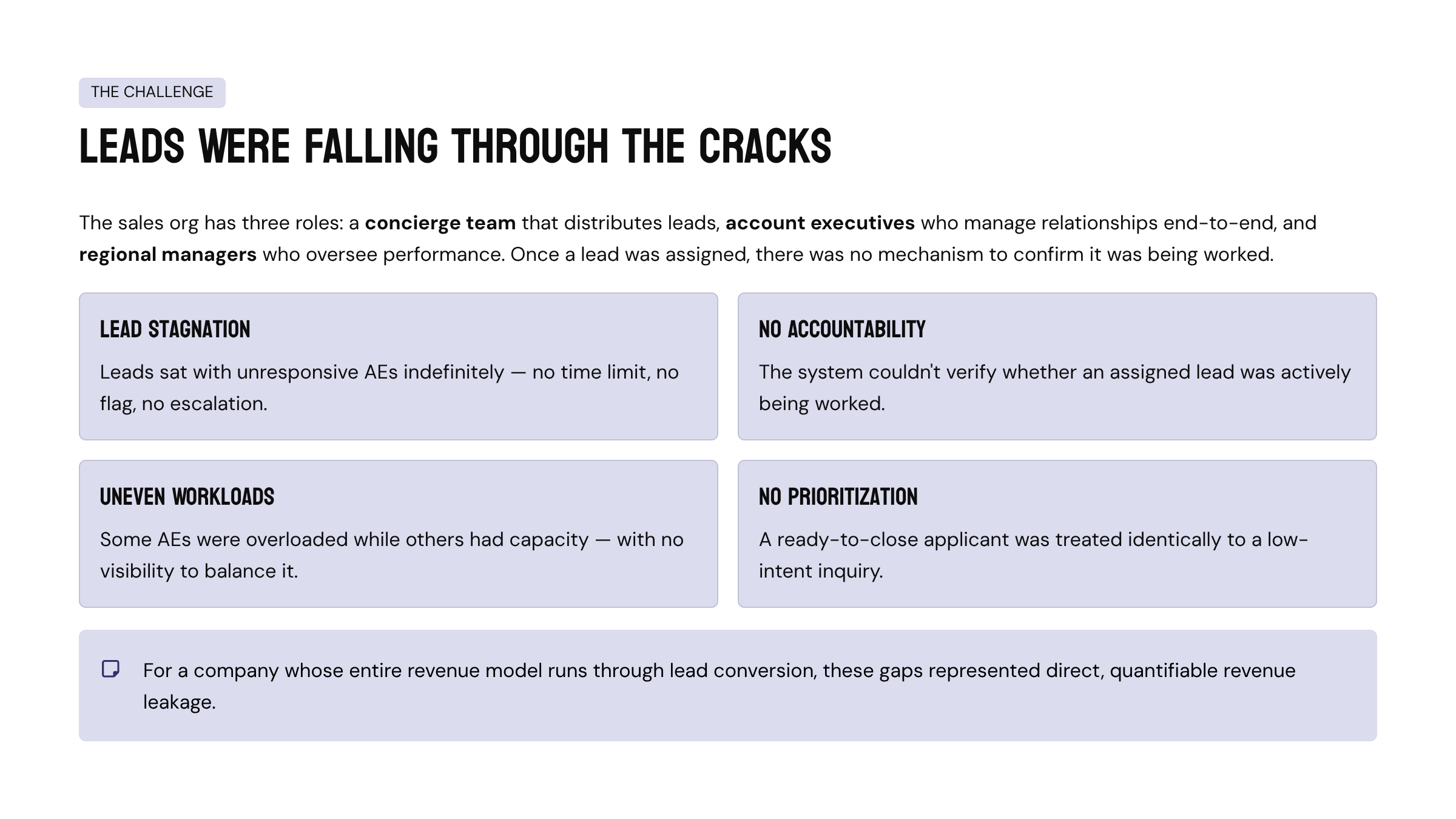
For a company whose entire revenue model runs through lead conversion, these gaps represented direct, quantifiable revenue leakage.
The Solution
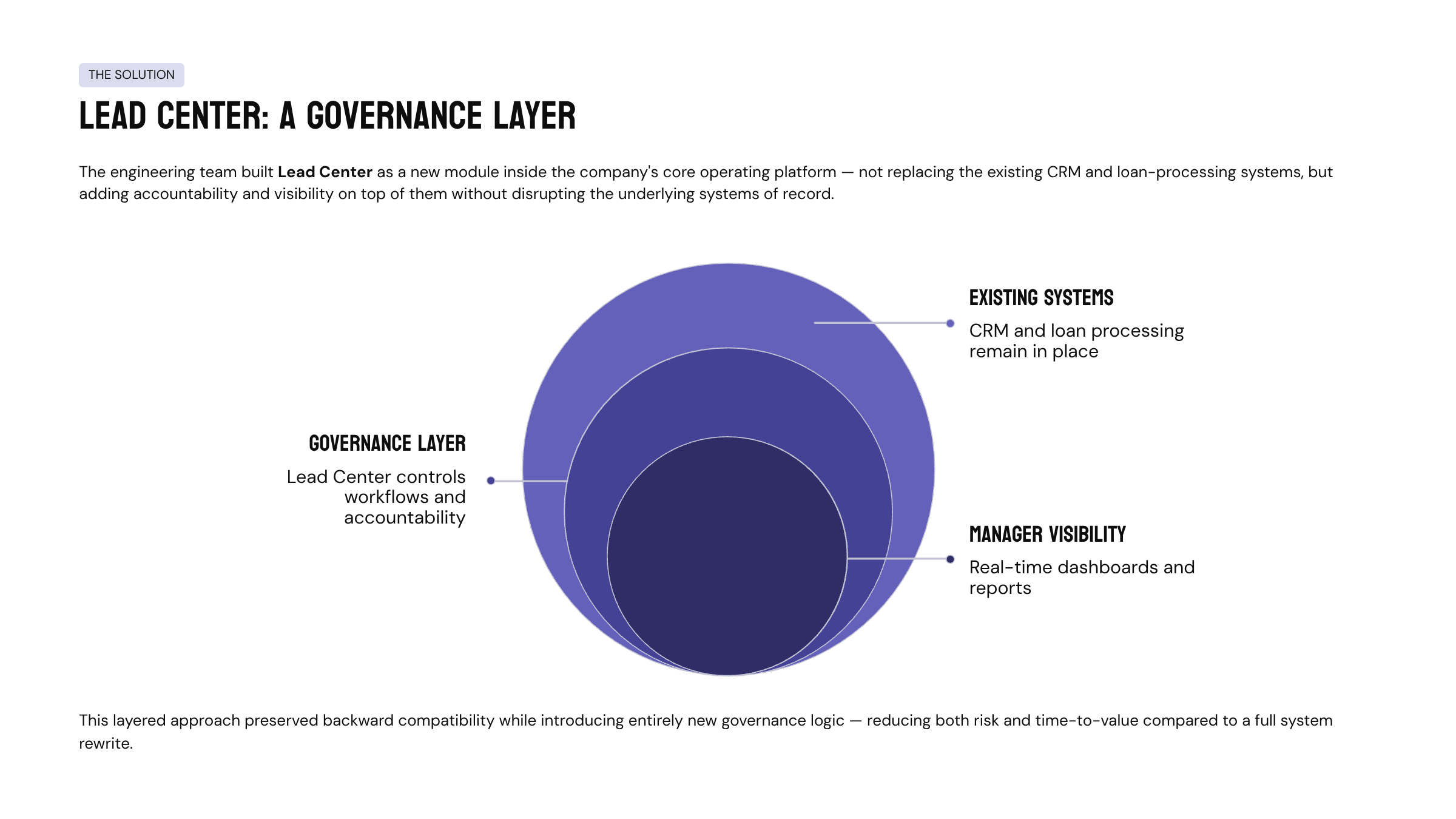
The engineering team designed and shipped a new module (internally called Lead Center) inside the company’s core operating platform. Rather than replacing the existing CRM and loan-processing systems, Lead Center was built as a governance layer on top of them, adding accountability and visibility to the lead lifecycle without disrupting the underlying systems of record.
Rules-Based Lead Claiming
Account executives no longer have leads pushed to them indefinitely. Instead, a personalized queue surfaces the next-highest-priority lead each account executive is eligible to claim. Two compliance flags enforce follow-through:
- A “claimed” flag requires the account executive to take action on a newly claimed lead before they’re allowed to claim another
- A “no activity” flag blocks new claims until all previously assigned leads have been worked
Together, these two rules close the loophole that allowed leads to accumulate unworked.
Automated Nightly Governance
A scheduled overnight process audits both account executives and leads. If an account executive misses a conversion deadline or shows no activity, the system automatically unassigns the lead and returns it to the pool for another account executive to claim. Leads that get unassigned repeatedly, or sit unclaimed too long, are automatically routed to marketing nurture or back to the concierge team, ensuring nothing gets permanently stuck.
Priority-Based Deadlines
Every lead is assigned a grade, reflecting how time-sensitive it is, with a corresponding deadline for progressing through pre-qualification and full application. Missing a deadline triggers automatic unassignment. This effectively puts a countdown clock on every open lead in the system, replacing what had previously been an unmonitored, indefinite holding pattern.
Manager Visibility and Fraud Prevention
Managers gained a read-only view across the full pipeline, including complete assignment and unassignment history for every lead, plus a statistics dashboard tracking claimed, converted, stale, and exited leads, filterable by account executive and region. A companion review tool flags a specific abuse pattern: cases where an account executive recreates a contract for the same borrower shortly after that borrower’s prior contract fell out, which can indicate gaming of the assignment system.

Technical Approach
The platform’s engineering team built Lead Center on the company’s modern application layer, which sits alongside a decades-old legacy CRM system still in use for parts of the mortgage lifecycle. Rather than migrating that legacy system outright (a multi-year undertaking on its own) the team extended the existing schema with new, purpose-built tables for lead monitoring and assignment auditing, preserving backward compatibility while introducing new governance logic.
The system integrates with several external services critical to daily operations: telephony webhooks confirm when an account executive has actually called an applicant, automated email reports keep account executives informed of leads at risk, and the company’s CRM of record is kept in sync in real time whenever a lead’s status changes. Notably, the team used an AI coding assistant throughout development to rapidly prototype and validate different implementation approaches before committing to a final design, accelerating a project that touched a legacy system with significant hidden complexity.
Key Takeaways
- Accountability has to be systemic. Manual processes for lead follow-up break down at scale; automated deadlines and flags close the gap that policy alone can’t.
- Legacy systems don’t have to block modernization. A governance layer can be added on top of an existing core system without a full rewrite, reducing both risk and time-to-value.
- Visibility drives better management, not just better reporting. Once managers could see pipeline health in real time, they could intervene before leads went cold, rather than discovering the problem after revenue was already lost.
- Prioritization logic compounds returns. Treating every lead equally wastes the advantage of knowing which ones are actually ready to convert.
- Fraud and gaming risks scale with automation. Any system that rewards claiming activity needs a corresponding check for abuse of that same mechanism.
Expected Business Impact
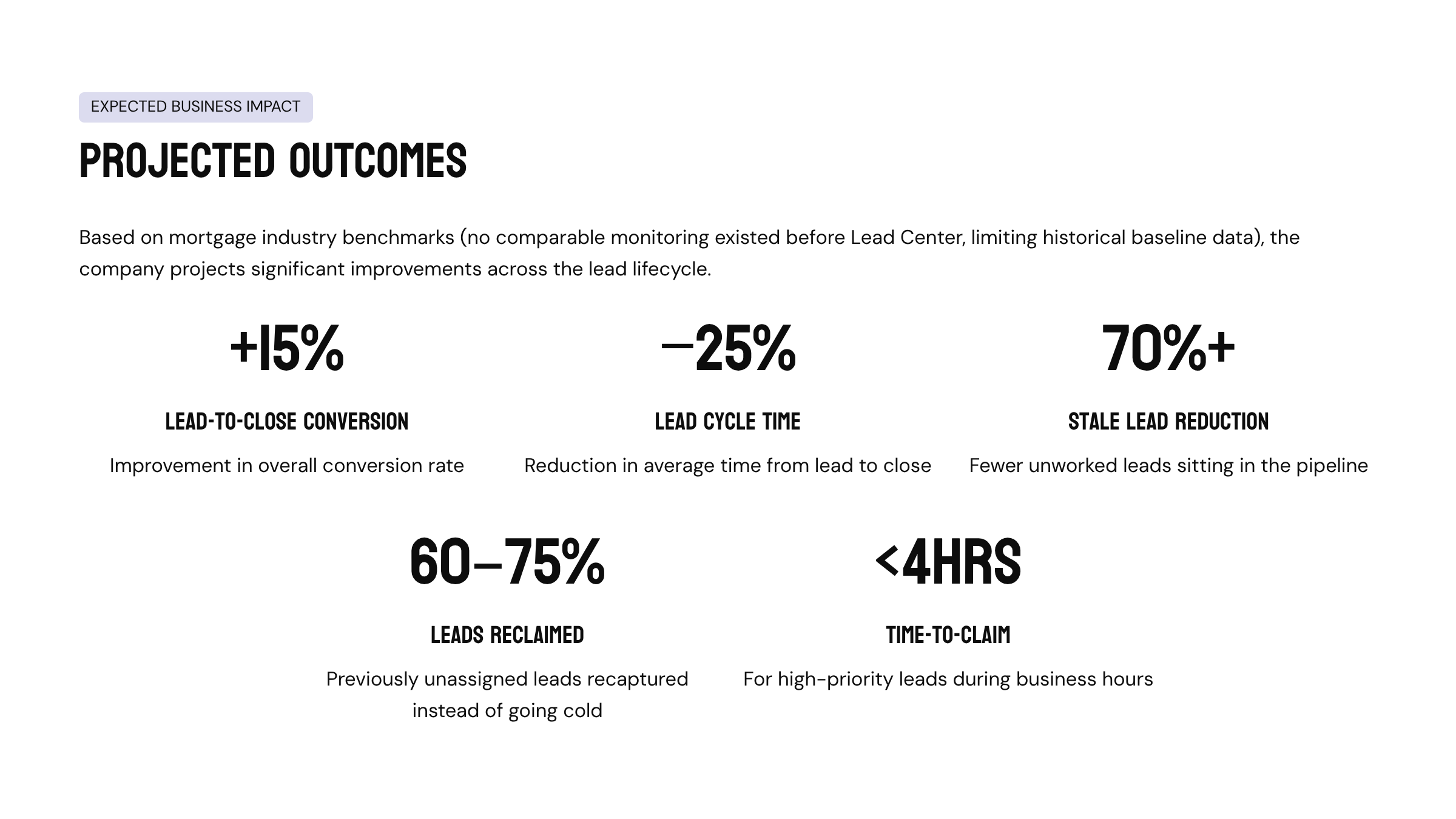
Based on mortgage industry benchmarks (the client’s own historical baseline data was limited, since no comparable monitoring existed before Lead Center), the company projects:
Conclusion
For lending platforms, the biggest scalability constraint is often the lead governance, including whether the system can guarantee that a qualified applicant is actually being worked before they lose interest or find financing elsewhere. By layering automated accountability, prioritization, and visibility onto an existing platform rather than rebuilding it, the client was able to close a longstanding operational gap without disrupting a system its entire sales organization depends on daily. The approach offers a broader lesson for any financial platform managing high-value leads through manual or semi-manual assignment processes: the fix is rarely more leads. First, you need to make sure the ones you already have don’t fall through the cracks.








![[SIGNALS] Interview with Bettina Rubek Slater](https://insart.com/wp-content/uploads/2026/06/signals-interview-with-bettina-rubek-slater-300x169.png "The Fortnight That Could Save Your Startup: Interview with Bettina Slater")