
Speed is a double-edged sword for founders. Move too slow, and you miss the moment. Move too fast in the wrong direction, and you waste time you’ll never get back.
This founder came to us with both urgency and ambition: a big vision, an investor timeline, and a detailed brief that looked airtight at first glance. But in early conversations, it became clear that what was on paper wasn’t what would get the MVP into the market in time.
We went from that first brief to a working demo in 42 days — this case study shows how the process unfolded.
Initial Kickoff
When the initial brief arrived, it outlined a strong vision: a defined product goal, detailed feature list, and an ambitious delivery timeline tied to upcoming investor discussions.
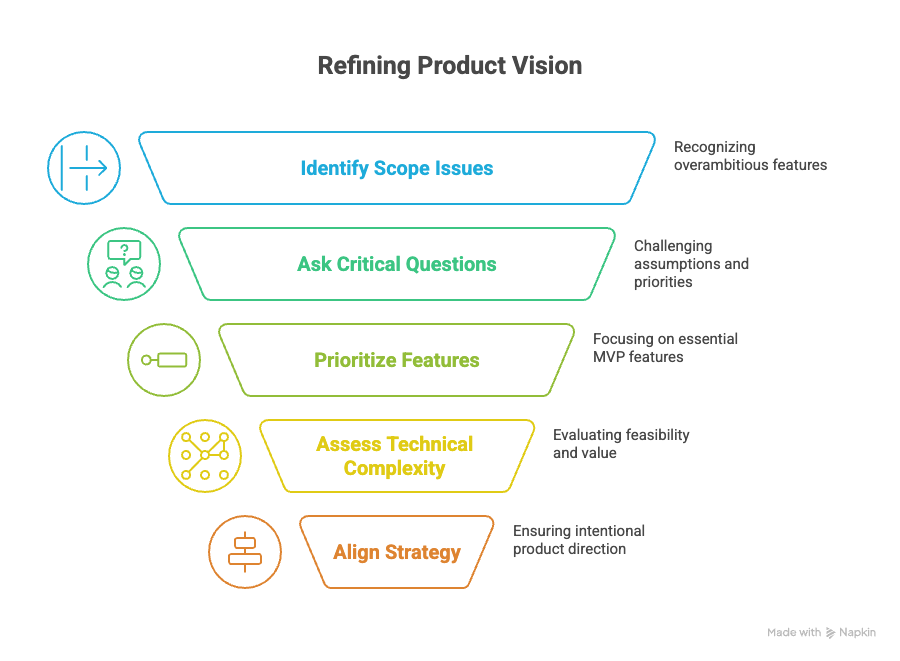
At first glance, the scope appeared complete. But during the kickoff, we realized that it was heavily feature-loaded, ambitious beyond the available time frame, and filled with ideas that were appealing but not essential for an MVP.
Building everything at once would have increased risk: more delays, higher costs, and a diluted core value. So we did something worth risking: we pushed back to ask the uncomfortable questions upfront.
- If we had to ship in three weeks, what would we cut?
- What is the core use case or atomic unit of engagement?
- What are users truly trying to achieve with feature requests?
- What is the technical complexity versus strategic value of each feature?
- Is this product direction driven by inertia or intentional strategy?
That’s when the real work began.
The Realignment Phase
That initial workshop made one thing obvious: the scope was set to deliver all features, instead of zeroing in on what would drive adoption first. That’s a common trap for early-stage founders, and one that can add months and burn a budget without getting you any closer to market validation.
We shifted the conversation from “everything the product could do” to “the smallest thing that proves it’s worth doing at all.”
Now, the MVP’s real job was to get traction. Once that shifted, so did everything else. Here’s how it all played out:
- We narrowed the scope to one clear, defensible problem the product would solve. Everything else, even smart ideas, went into the parking lot.
- We mapped just two workflows that directly delivered the core value and would get early users to engage. If a feature didn’t feed into those flows, it didn’t make the cut.
- Together, we picked early indicators: active usage and repeat engagement. So, every decision had to move those numbers.
- For complex features that would take weeks, we introduced manual or low-tech workarounds so we could still demonstrate the value without delaying the launch.
This realignment reoriented the entire build toward validating the product’s viability with real users.
The Build Phase
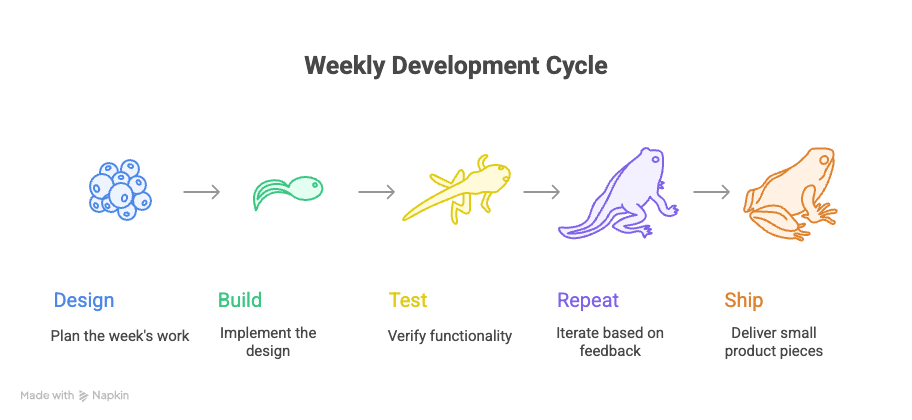
Once the scope was clarified, we broke the work into tight weekly cycles: design, build, test, repeat — so we could keep shipping small pieces and adjusting as we learned.
Key features in the first drops:
- A functional onboarding flow (to get real users in fast).
- The core transaction workflow — the “moment of truth” for the product.
- Basic analytics so the founder could see usage from Day 1.
Of course, no build goes exactly as planned. Halfway through Week 3, an integration we assumed would be straightforward turned into a rabbit hole with undocumented APIs, conflicting data formats, and a vendor who took their sweet time replying.
To make sure we took everything from the time we had, we pivoted, mocking the integration for demo purposes and building the rest of the flow around it, so nothing else stalled. That single decision kept the 42-day target alive. There were other small scope adjustments too: trimming secondary screens, reusing components, postponing advanced settings. Each cut was a trade-off in favor of progress.
By the end of Week 5, the MVP felt real. Not finished yet, but ready enough to show and click through.
The Launch
Six weeks in, we launched an MVP that did one thing well: run a complete user flow without shortcuts. That was enough to prove the concept.
We rolled it out to a targeted group of early users. The feedback split evenly between validation and improvement:
- Confirmation that the core workflow solved the intended problem.
- Specific points of friction we could address in the next iteration.
From there, the founder moved quickly. With a functional product instead of a pitch deck, investor meetings shifted in tone (less theory, more demonstration).
The rest is the story: founders had follow-up calls and serious interest from investors who had previously been in “wait and see” mode. The MVP had done its job — providing evidence that the market wanted what they were building.
Reflection: Lessons From 42 Days
Looking back, the founder’s biggest takeaway was this: fewer features can lead to stronger validation. By resisting the temptation to build everything up front, they launched faster, reached users sooner, and had concrete progress to discuss with investors.
The original brief had aimed for a polished, “complete” product. It took some early rethinking to accept that traction was the real goal. Narrowing the scope to a few critical workflows not only proved the concept but also gave the founder something tangible to demonstrate. That demo changed investor conversations almost immediately, shifting them from abstract discussions to concrete opportunities.
From our side, this project reinforced something we’ve seen many times before: the real work begins when you challenge assumptions, not when you start building. A tight focus accelerates both delivery and learning, and the so-called “ugly middle” — the re-scoping, the trade-offs, the pivots — is often where the path to product-market fit starts to take shape.
In this case, six weeks was enough to turn a high-level idea into something real, testable, and worth showing.
Have an idea you need to get in front of users or investors fast? Fill in the form and tell us about it — we’ll help you find the fastest path to something real.