


If you’ve been around enough early-stage teams, you start to notice the same pattern — rushing to build before the idea is truly ready. The impulse often comes from external pressure: investors want demos, engineers need tasks, competitors launch. It’s easy to convince yourself that building and shipping quickly is the answer. But that “progress” can be an expensive illusion. We’ve seen it drain months of work, burn through precious capital, and leave founders with a product no one’s asking for.
At INSART, we work with fintech founders and too often, we meet them right after they’ve made the same early mistakes we made ourselves — burning time and money on features that never get traction. This guide is about helping you avoid those traps and channel that urgency into real, validated progress.
The build energy trap
Build energy is that itch to ship something — anything — just to prove you’re moving. It’s not inherently bad; urgency keeps teams alive. But unchecked, it can steer you into work that looks like progress but isn’t.
Fast launches deliver a quick dopamine hit. Screenshots go in the deck, team morale ticks up, and you can tell yourself you’re keeping pace with the market. But when speed becomes the metric, it gets confused with progress. True momentum comes from validated learning, not just velocity.

THE COST OF BUILDING TOO SOON
So what actually happens when you build too early? Here’s what we’ve seen firsthand.
You build features based on assumptions
Every startup begins with a set of educated guesses: who the customer is, what problem they care about, how they’ll use your product, and whether they’ll pay for it. These assumptions are unavoidable in the beginning, but the longer they go untested, the greater the risk that you’re building for a user who doesn’t exist, solving a problem no one truly feels, or adding features no one will use.
The opposite approach — building in isolation — often comes from a misplaced confidence. Many first-time founders assume they already know the customer’s problem and the solution it demands. This skips the most important part of customer development: actually talking to users and hearing, in their words, what matters most. Without that validation, you risk locking yourself into a product direction that’s costly to reverse. The logic is follows:
- Markets pay only for unmet needs.
- You can’t know those needs without hearing them from real users.
- Skip this step, and you’re likely solving a problem that was never there.
Experienced founders treat assumptions like hypotheses. They write them down, run small experiments, and gather real user feedback before committing to full-scale development. Early versions of the product become the tools for testing market truths. The focus is on proving or disproving core beliefs, not shipping as many features as possible.
So, validate the pain before you build the cure. Everything else is a gamble you can’t afford at this stage.
You Burn Money and Time Without Clear Signals
Scaling before you have clear market signals isn’t just a rookie mistake — some founders call it the silent killer of startups. It doesn’t always look like a disaster at the moment. In fact, it often feels like progress: new hires, new features, new infrastructure. But without proof that the market wants what you’re making, you risk ending up with unsold products, unused infrastructure, and expensive pivots.
Take Clinkle as an example of what not to do:
Clinkle, a Stanford-founded mobile payments startup, raised an unprecedented $25–30M seed round from elite investors like Andreessen Horowitz and Peter Thiel. But despite the hype, the company pivoted repeatedly, without ever proving a real customer need. Long launch delays, secrecy, and internal churn eroded trust. By 2016, Clinkle had shut down, remembered less for innovation and more as a cautionary tale: funding can’t replace market validation, and building too soon without clear signals can sink even the best-backed teams.
The fix is disciplined validation: launch early to learn, and let evidence guide what you build next. The well-worn line “If you’re not embarrassed by the first version of your product, you’ve launched too late” still holds truth — but it’s often misinterpreted. It’s not a call to build recklessly. It’s a call to launch early enough to learn, and to learn before you overcommit.
The Smarter Way: What to Do Instead
Avoiding the build-too-early trap means learning fast enough to make every step count. Before we get into concrete steps, let’s talk mindset — shifting from build-first to signal-first. The idea is about reversing the default startup instinct: instead of writing code right away, you first look for signals that your product idea is worth building.
In practice:
- Build-first = Start coding an MVP or feature to “show progress” before you’ve validated if anyone wants it.
- Signal-first = Test whether there’s real demand, urgency, and willingness to adopt before investing in heavy development.
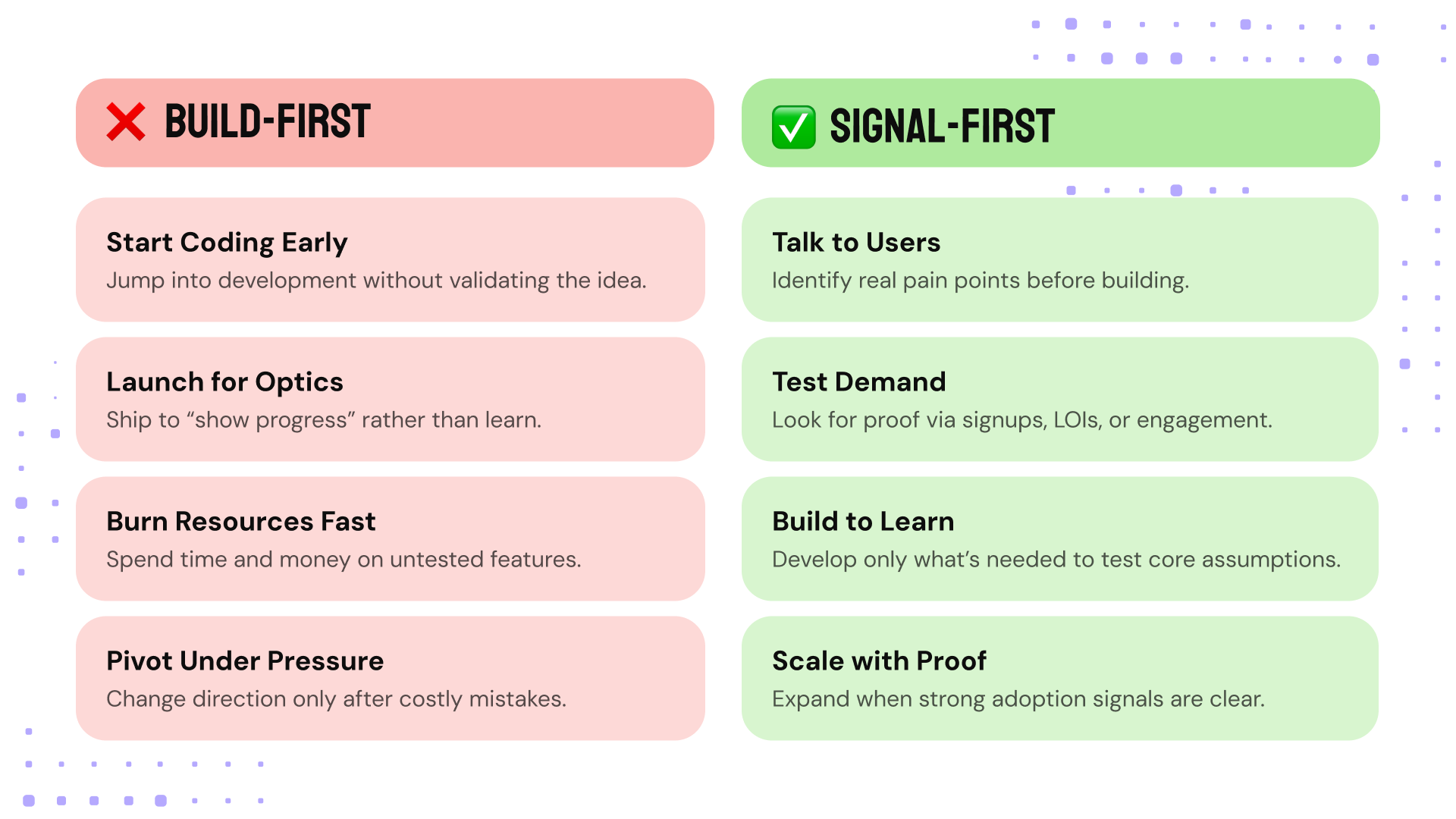
Signals can come from:
- Real conversations with potential users where pain points are clear and urgent.
- Pre-launch signups or waitlists.
- Commitments like letters of intent, early payments, or pilot agreements.
- High engagement with a prototype, demo, or concept.
- Metrics that prove the problem exists and is worth solving.
Signal-first ensures you’re building something people will use, not just something you can build. It reduces wasted effort, shortens the path to product–market fit, and makes investor conversations stronger.
6-WEEK PROCESS IN ACTION
At Insart, we use a 6-week process — a structured, time-boxed approach to go from a vague idea to clear, validated direction, without sinking months into full-scale development. Here’s how it works, step by step:
Step 1: Talk to Users First
Get out of your own head and into theirs. Have direct conversations with potential users before you write a single line of code. Ask about:
- The problems that keep coming up in their workflow.
- How they’re solving (or working around) them today.
- What’s frustrating or expensive about those solutions.
Look for repeated patterns and strong emotional reactions — those are your early signals of real demand.
Step 2: Test Interest Before You Build
Instead of building a working product to see if people care, use low-effort experiments like:
- A simple landing page with a clear value proposition and a sign-up form.
- A clickable mockup or prototype.
- A short, vivid story that explains the product’s use case.
The goal here is to watch for behavior that signals real interest: sign-ups, replies, shares, or commitments.
Step 3: Clarify the One Question Your MVP Must Answer
Your MVP is not “the first version of your product.” It’s an experiment designed to answer a single, high-risk question. Examples:
- Will users pay for this?
- Will they switch from their current tool?
- Can we deliver this value reliably?
Everything in your MVP should exist to test that question, and nothing more.
Step 4: Make Signals Your Metric
Redefine progress. Instead of tracking how many features you’ve shipped, track the number of real signals you’ve collected — things that reduce risk and increase confidence in your market fit. When you build based on signals, you’re moving in the right direction.
Wrapping up
These days, when a founder asks, “Can’t we just build an MVP in a month?” we flip the question:
What do you need to learn in the next 30 days that could change your roadmap?
How will you measure it without writing 5,000 lines of code?
That’s why our 6-week process at INSART is built around learning fast, not just launching fast. We help founders test signals, validate pain, and refine their MVP scope before heavy development starts — a disciplined approach that makes products stronger and fundraising conversations sharper. If you want to avoid the costly detours we’ve seen too often, we’re here to help you take the smarter path from idea to impact.


