![[SIGNALS] Banner & visuals for the Interview_ Giorgio Natili (1)](https://insart.com/wp-content/uploads/2026/05/signals-banner-visuals-for-the-interview_-giorgio-natili-1.jpg "The Best Scaling Decision You'll Make Has Nothing to Do With Infrastructure: Conversation with Giorgio Natili")
There is a moment every high-growth startup dreads: the realization, usually arriving too late, that the product holding up their pitch deck cannot hold up their customers. The architecture wasn’t built for what came next, the compliance gaps compounded, the team that launched version one couldn’t keep pace with version two, and the company had been optimizing for entirely the wrong thing.
Our guest, Giorgio Natili, has seen this moment more times than he can count. A engineering leader with over 20 years of experience spanning FinTech, payments, browser technologies, and large-scale AI systems — with stops at Mozilla, Capital One, and currently OPAQUE Systems, where he leads confidential AI architecture strategy — Giorgio brings a rare combination of technical depth and organizational candor to the question of what scaling requires.
In this conversation, he challenges some of the most durable assumptions in startup culture: that the MVP model is still fit for purpose, that compliance is a burden rather than a barrier to entry for competitors, and that the engineering talent playbook hasn’t been rewritten by AI. For founders and investors trying to separate real scaling readiness from a well-rehearsed pitch, what follows is worth reading carefully.
Rethink the MVP Before the Market Does It for You
Ask most founders when a startup should begin rearchitecting its product, and they’ll cite familiar metrics: user counts, transaction volumes, team headcount. Those signals matter, but they’re trailing indicators. By the time they flash red, the technical and strategic debt has already compounded. But what if the very concept of the MVP needs to be retired?
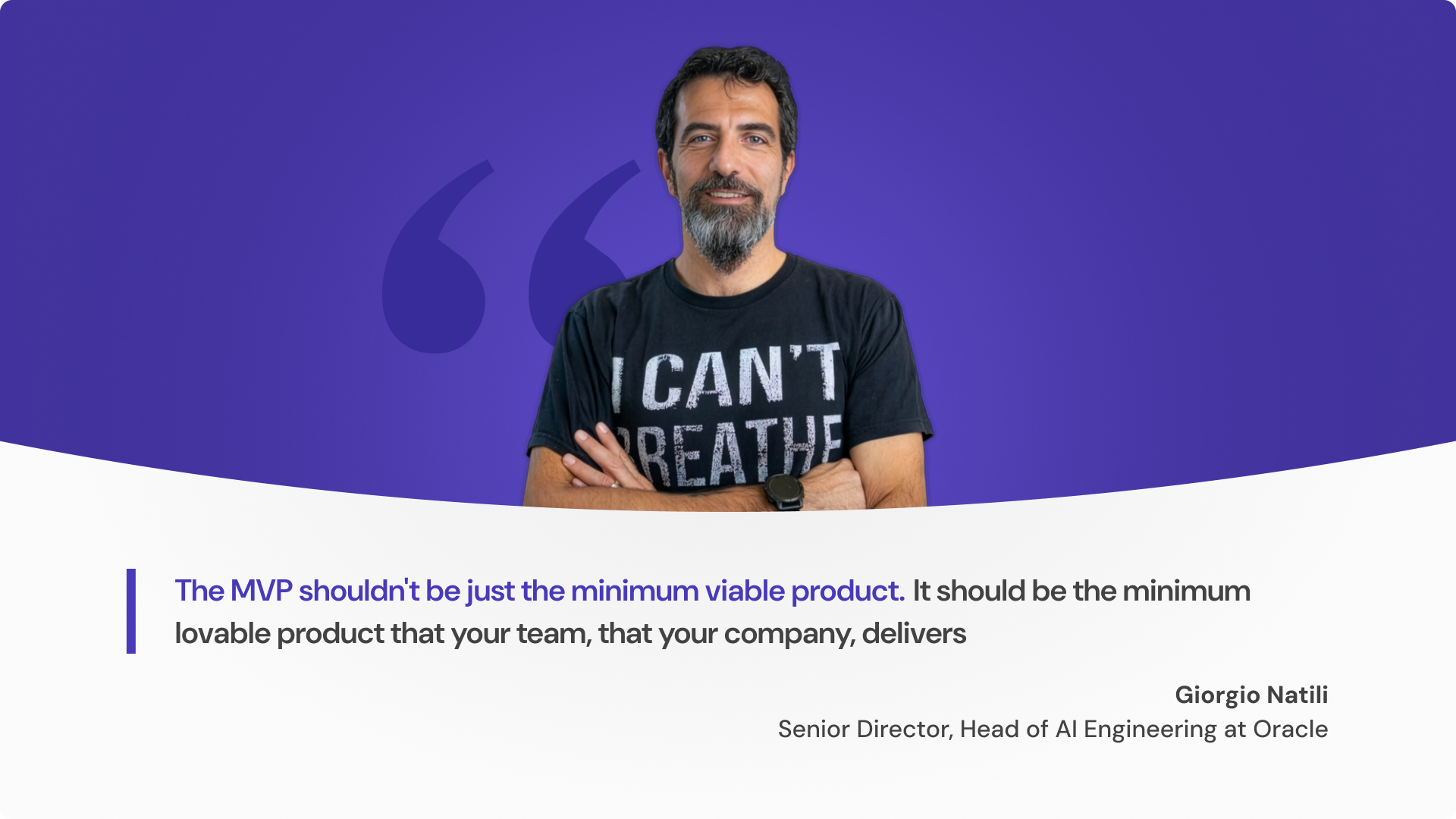
“The MVP shouldn’t be just the minimum viable product. It should be the minimum lovable product that your team, that your company, delivers,” shares Giorgio Natili – Head of AI Engineering, Board director, and Career Coach.
A minimum viable product optimizes for speed to market. A minimum lovable product optimizes for user experience. And in a world where generative AI can dramatically compress development timelines, the traditional trade-off between quality and speed has collapsed. Founders no longer have to choose.
This argument is grounded in a shift that accelerated dramatically in early 2025. The emergence of tools like Claude Code and a wave of AI coding releases changed the fundamental economics of software development.
“Think that right now, LLMs are already capable of writing 20% of their code by themselves. So if we reach that level, we can definitely start doing a more mature switch to removing the underpinning meaning of ‘vibe coding’, because vibe coding can sound like everybody can code. Sure, everybody can code. But who can code effectively is who is thinking about what the tool is generating and who is playing an adversarial role with AI.”
AI-assisted development changes what it means to incur technical debt in the first place. Teams that use AI to continuously validate code quality, enforce standards, and automate review gates inside their GitHub or GitLab pipelines can maintain production-grade architecture from the earliest stages of a product, rather than scrambling to achieve it at the moment of scale.
“When you need production,” he explains, “you will not be anymore in a situation where, ‘Oh my God, now I have to go back and refactor everything.’ You train it yourself, your company, your customers, your team — it will continue refactoring and improvement, supported by the AI tools that we have right now.”
The Scaling Mistake That Has Nothing to Do With Technology
When founders ask about common scaling failures, the expectation is usually a technical postmortem; a war story about a database that buckled under load, or a monolith that became impossible to decompose. But the most dangerous scaling mistake in Giorgio’s opinion is going to market without product-market fit and convincing yourself, through motivated reasoning, that you have it.
“I saw that in one couple of startups that I worked with — one specifically was keep iterating on the same concept, because that concept was very easy to index and propose as a unique concept of the setup. But in reality, a customer really didn’t need that, and they were justifying themselves, saying, ‘Oh, the customer are not mature enough to understand that they have this problem.’ Wrong perspective. If the customer is not mature enough, it means that your product is not mature enough and that you’re not communicating the right message.”
Imagine having two or three years of iteration, a full fundraising cycle burned through, and an exit that (if it comes at all) won’t return meaningful value to investors or founders. The root cause, in nearly every case, is a team that optimized for the elegance of its own idea rather than the evidence from its customers.
The corrective is a rigorous product partnership program (what the industry calls a design partner model) that transforms would-be customers into co-creators. But the execution matters enormously.
“Make them engage. Explain to them what they can do to benefit not only you, but to benefit themselves. Offer roundtables. Offer a learning experience for them. Make them fully part of your design process, and leverage them when you cannot connect from a business standpoint, to help your product-market fit to begin something that can be meaningful for your customers,” Giorgio shares.
A startup with a serious design partner program is de-risking its product assumptions in real time. A startup with a compelling demo and no design partners is still running on theory.
The Compliance Edge: Why Regulation Is a Strategic Asset
For FinTech founders especially, no scaling conversation can avoid regulation, and yet the default posture in many early-stage teams is to treat compliance as a problem to solve later, after product-market fit has been established. This is precisely backwards.
“If you don’t have an understanding of the regulations that regulate your FinTech business, you will never be able to scale, because at some point, you will find yourself that you made so many decisions product-wise that to undo those decisions, you will destroy your product-market fit,” explains Giorgio.
The objection that is common among founders who fear that regulatory rigor will slow them down misses a more useful reframe. Modern AI tooling has dramatically lowered the cost of regulatory intelligence. Founders can use prompting and automated analysis to map applicable regulations, assess their product against those requirements, and generate compliance scoring dashboards that give them real-time visibility into gaps.
“You can have AI doing this for you. Then you have to put your brain at work right after AI gives you a blueprint, and you make it unique to your own use case. And then you can use the same outcome to generate two things: one, specs to validate that your product is really fitting into that — and second, you can also generate code quality and process assessment.”
The strategic payoff is significant. A team that knows its compliance gap (say, 80% implemented with a defined 20% outstanding) can walk into a customer conversation with specificity and credibility. They can tell a prospective enterprise client exactly how many weeks to a compliant go-live, rather than making commitments they cannot keep.
“You avoided making one of the mistakes that comes in many times,” Giorgio notes. “‘Oh, we can go live in one week.’ Sure, yes. And then it never happens. And you eroded the trust not only in your startup, but in the startup ecosystem.”
Regulation, framed this way, is not a ceiling on innovation. It is a forcing function for product maturity and a competitive moat for teams disciplined enough to build it early.
Building for Rapid Growth: The Team Is the Architecture
If the conversation on technology has been iconoclastic, the perspective on hiring for scale is equally so. The premise that a startup needs a large engineering team to move fast is, at this point, a relic of a pre-AI hiring model.
Giorgio points out to Instagram that it scaled to hundreds of millions of users with a team of around a dozen engineers. Platform businesses serving billions of users today operate with headcounts in the low hundreds. The constraint was never arithmetic.
What changes with AI augmentation is the skills profile that founders should be hiring for. The traditional calculus, roughly 75% technical competence and 25% behavioral fit, has inverted.
“I think that the balance now is at least 50/50, if not more, because the technical gaps can be overcome very easily if you have the attitude. But the right attitude takes years to be built,” Giorgio emphasizes.
The behavioral quality that matters most, in this framing, is an almost allergic sensitivity to rabbit holes — the ability to recognize when curiosity is becoming a liability, and to reorient toward delivery. The guiding principle is unambiguous: “Delivery is the currency of trust, and this is true inside the company and outside the company.”
The hiring process itself should reflect this shift. Rather than coding exercises that test knowledge candidates will never apply in a world of AI-assisted development, founders are advised to use AI as a first-class component of the interview itself: ask candidates to solve real problems with AI tools, and watch how they think, challenge, and interrogate the output.
On behavioral assessment, the recommendation is to borrow from proven frameworks rather than reinventing them. Amazon, Snowflake, and Google have all published leadership principles that can be adapted to an early-stage context.
“Pick two, three of them that are important for you. Use them. Piggyback on that and assess your team. Build it up and try to see how it flies — and if it doesn’t, don’t be scared about changing things. There is nothing better than failing fast and learning. The important thing is to not fail continuously on the same aspect.”
The Scaling Conversation Has Changed. Has Your Company?
The through-line of this conversation is not, ultimately, about technology. It is about intellectual honesty. The founders and technology leaders best positioned to scale are those willing to be self-critical about their product, rigorous about their customer evidence, disciplined about compliance, and surgical in who they hire.
The AI moment has lowered the cost of almost every technical problem that once consumed early-stage teams. What it cannot fix is a product no one needs, a team no one has thought carefully about assembling, or a regulatory exposure that was always visible and always deferred.
The tools have changed, but the fundamentals have not. And for the founders who understand the difference, the window to scale something that lasts, something that is not just viable, but genuinely lovable, has never been wider.


![[SIGNALS] Banner for interview with Mark Beeston](https://insart.com/wp-content/uploads/2026/04/signals-banner-for-interview-with-mark-beeston-300x169.jpg "What It Takes to Raise in Fintech: Insights from Mark Beeston, Founder of Illuminate Financial")