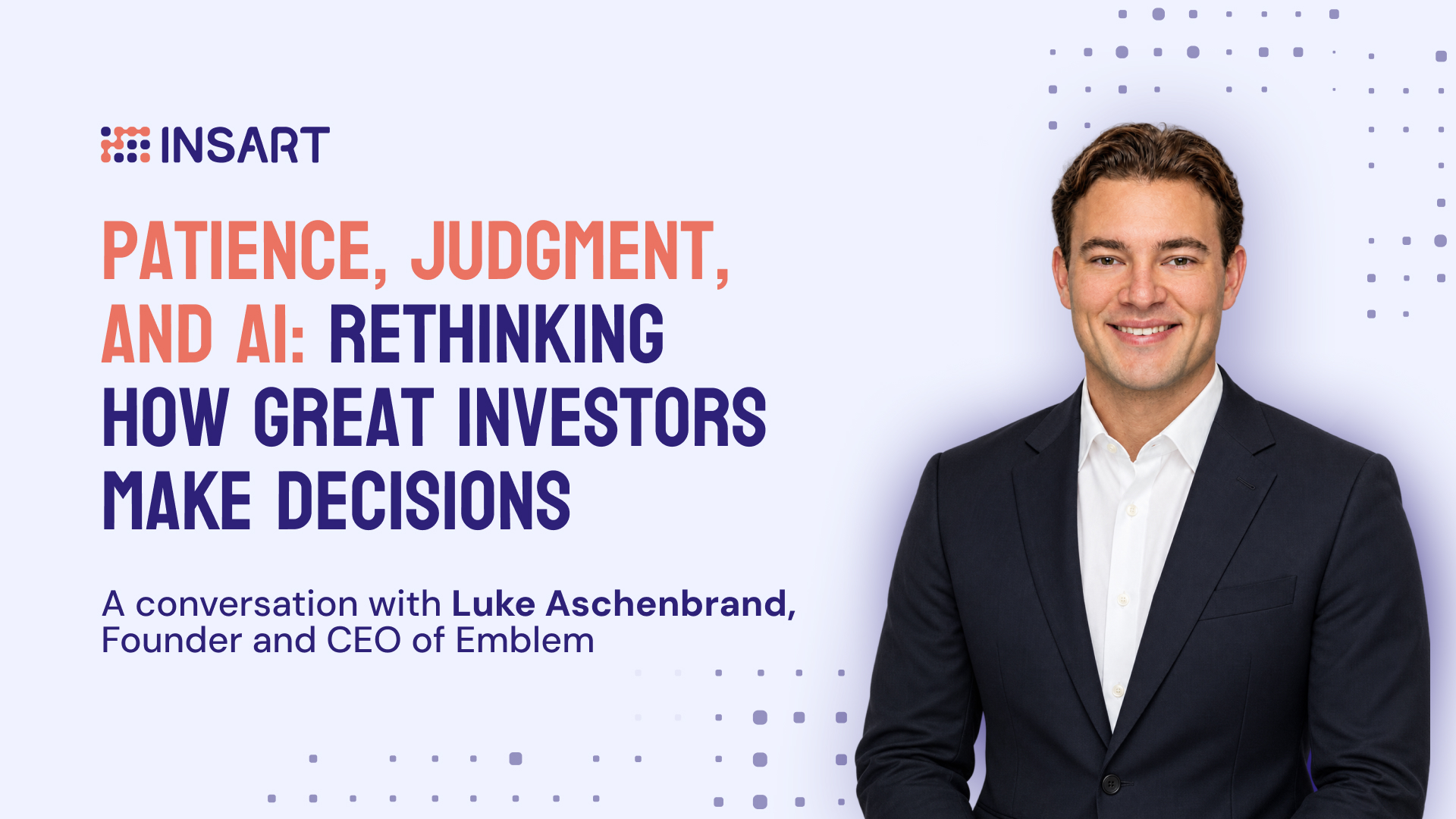
Before he was building AI for institutional investors, Luke Aschenbrand was a Princeton philosophy student writing a thesis on patience. It’s a strange thread to pull on when you meet him now — running a company at the center of one of the most hyped corners of the AI boom — but it’s also the thread that explains almost everything about how he thinks. Patience, judgment, and the discipline to say no turn out to be the real subject of this interview, even though the conversation nominally starts with a decade-old undergraduate paper and ends with the future of investing.
We sat down with Luke to talk about what he’s learned moving through private equity, venture capital, accelerators, and family offices, and what he’s building now at Emblem to fix what he sees as the single biggest waste of institutional time: PowerPoints.
On patience, years later
Your Princeton thesis was titled “Patience, Its Limits, and How to Apply It.” Looking back, how has your understanding of patience evolved, from philosophy student to founder building AI for investors?
For Luke, patience has evolved into the daily cost of doing business. “Patience is the one skill I’ve needed the most over the past four years,” he says. “It takes more time than you think to achieve any goal; I’ve learned that the hard way.”
What’s changed is his appreciation for how far it reaches. “I didn’t realize that the skill had as much functional utility as it did when I wrote it. I only needed it to write the piece at that point in time.” The bigger lesson has been about how far patience can take you. “When you take the time to execute relentlessly and know when the right time to strike is, it will take FAR more volume than you might have thought originally.”
On what great investors actually have in common
You’ve worked across private equity, venture capital, accelerators, and family offices before founding Emblem. What patterns did you notice about how great investors make decisions, regardless of asset class?
Across every corner of the investing world he’s touched, Luke kept running into the same handful of traits. “The best investors are typically contrarian by nature,” he says. Beyond that instinct to go against the grain, there’s usually something structural underneath it: “They also, many times, either have a social, experience, or domain advantage.”
But the trait he comes back to most is restraint. “The other thing that stands out is discernment; saying no is more powerful than saying yes many times over.“
On the biggest time sink in institutional investing
Where do you think institutional investors lose the most time today? How is Emblem changing that?
You may be surprised at first, but Luke points out to PowerPoints.
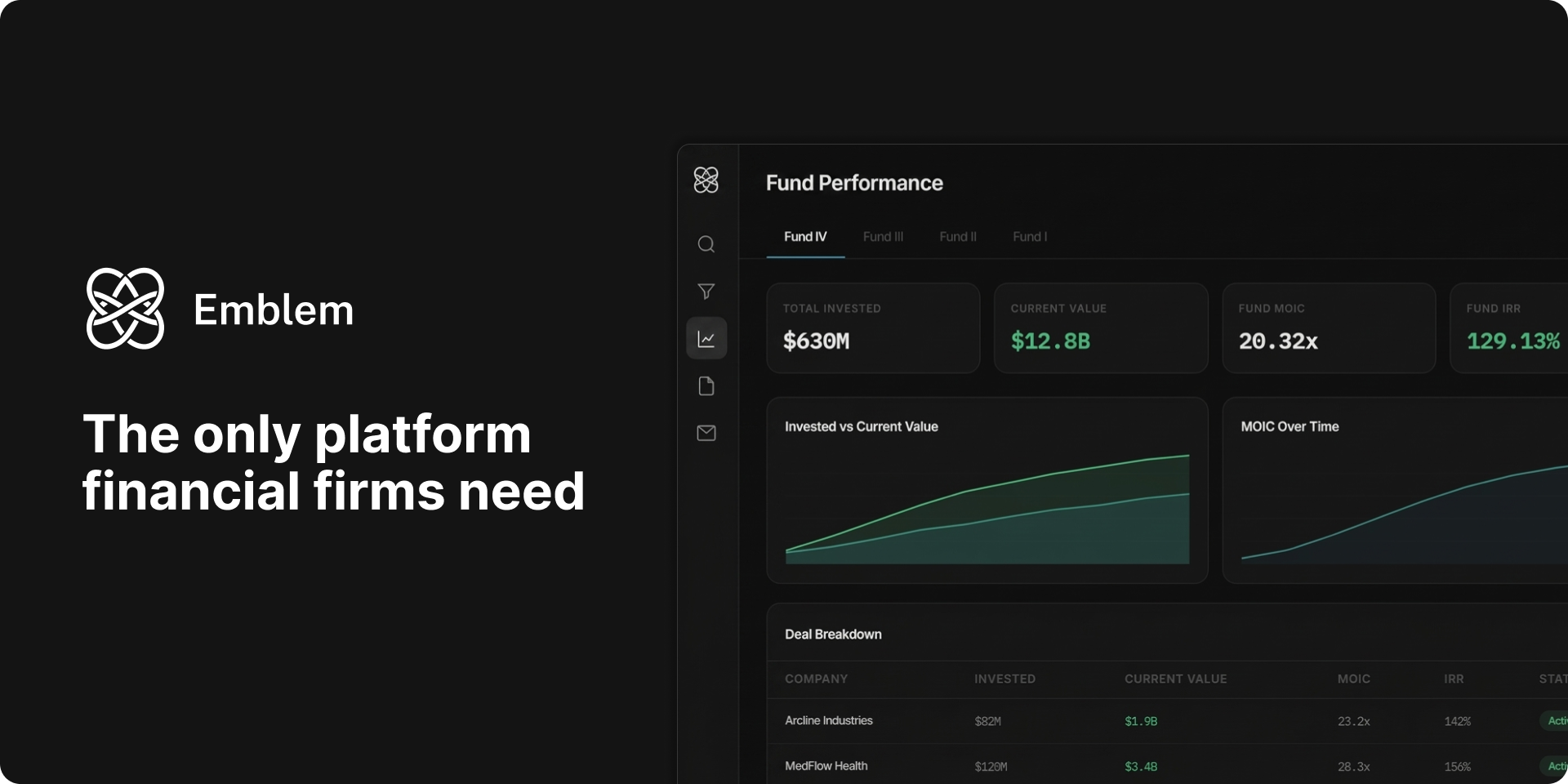
And it’s the problem Emblem was built to solve, and he points to a very specific, very recent data point to prove the appetite for a fix is real. “As of July 27th at 12 PM PST, we just got 200k+ views in three hours on a demo showing how data being linked back and understanding templates can change work,” he says. For Luke, the response itself is the evidence. “The amount of inbound showing real problems getting solved proves that the time is being spent on things a computer can do; the scale will come when firms see it happen on their work.”
On AI, judgment, and the “last mile” problem
There’s a growing fear that AI will automate investment decisions. Do you see AI replacing judgment, or simply changing where human judgment creates the most value?
This is the question Luke seems most animated by, and he pushes back hard on the premise. “Tech won’t remove judgment; it will heighten judgment,” he says. His reasoning flips the usual fear on its head: the more machines get good at pattern recognition, the more valuable human pattern recognition becomes. “If the world comes down to computers recognizing patterns across all domains of life, then humans recognizing new patterns will heighten the need for judgment.”
He frames AI’s real challenge as a logistics problem. “AI is a last mile delivery business model, meaning those who build for it will need to prove it does all the tiny, conceivable details,” he explains. “However, there are still those things that aren’t conceivable, but needed, to recognize patterns.” — and that gap, he suggests, is where human judgment lives.
On what AI gets wrong and what it gets right
Every major technological shift creates both advantages and new risks. Where do you think AI is being overestimated today, and where is its impact still widely underestimated?
Luke draws a line between two things people often conflate: how correct AI is, and how adaptable it is. “It’s being overestimated on accuracy, underestimated on adaptability,” he says.
He points to a familiar example to make the point concrete. “People are ‘training’ their AI to do a lot of things, but it still needs a human in the loop to understand and complete the work on complex tasks. For example, if you ask any LLM to build a spreadsheet, it’s surprisingly good at finishing the logic you asked for and can draft anything.” The catch is in the verification. “However, you won’t know until you scrutinize or review it whether or not it matches the standard, unless you add specific guardrails.”

On the one principle that matters most
If you had to leave readers with one principle for navigating the next decade of investing, what would it be?
No hesitation here. “Do your research!” Luke says. “The more research you do, the more context you have to make the best decision.” It’s a simple instruction, but he’s careful to note it isn’t a substitute for depth. If anything, it’s a demand for more of it. “The details matter more than the principle many times.”