

How fintech platforms scale engineering teams and system performance through microservices architecture
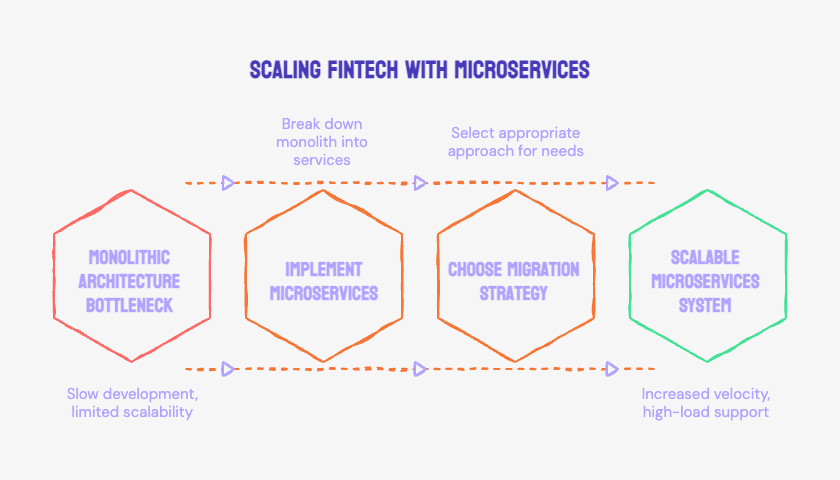
As digital financial products grow, their architecture often becomes the primary constraint on scalability. Early-stage platforms typically start as monolithic applications because monoliths allow teams to build and launch products quickly. However, once a product matures and both traffic and engineering teams expand, the monolithic architecture can become a bottleneck for development speed, reliability, and long-term scalability.
This case study explores how financial technology platforms transition from monolithic architectures to microservices-based systems. It highlights several real-world migration strategies used by fintech companies and explains when each approach is appropriate.
Migrating to microservices is not a universal solution, but when applied correctly, it allows organizations to scale engineering teams, increase development velocity, and build systems capable of supporting high-load financial operations.
The Challenge
Many financial startups begin with a monolithic architecture because it allows them to move quickly and validate their business model. In early product stages, the focus is on delivering features and reaching market fit rather than designing highly distributed systems.
However, as the platform grows, several challenges begin to emerge:
• increasing engineering team size
• rising system complexity
• slower development cycles
• difficulty scaling specific services independently
• growing operational risk during deployments
These challenges lead many organizations to consider migrating their systems toward a microservices architecture.
The industry trend toward microservices migration reflects the need for systems that support parallel development and scalable infrastructure. Companies increasingly recognize that re-engineering legacy monolithic systems is necessary to support long-term product growth.
The Advantages of Microservices
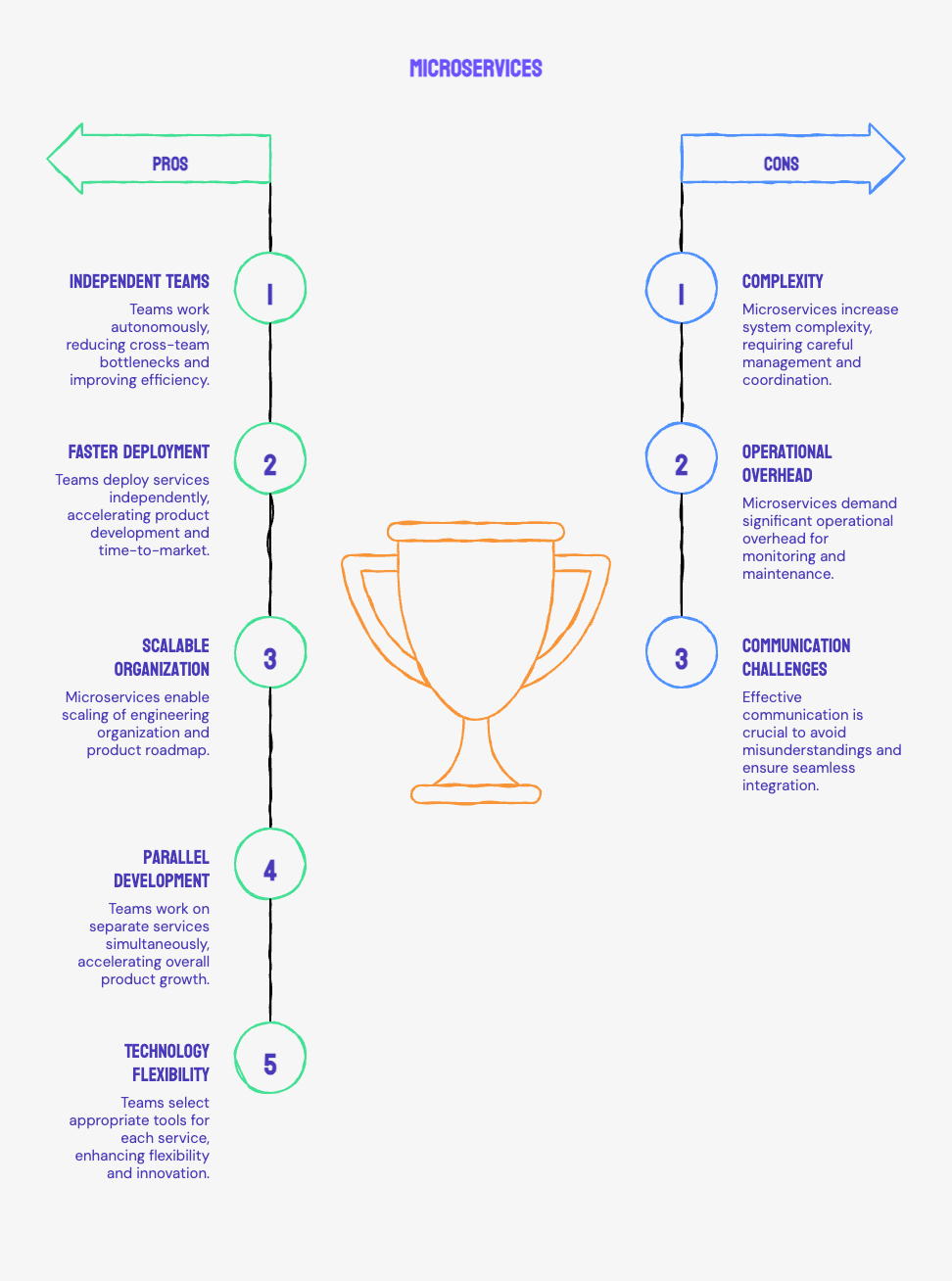
One of the key benefits of microservices is the ability to organize development teams around independent product domains.
In organizations adopting microservices, teams are often structured into autonomous squads responsible for specific parts of the product. Each squad typically includes:
• a product manager
• several engineers
• quality assurance specialists
This structure enables teams to design, build, and deploy services independently without creating cross-team bottlenecks.
As one fintech engineering leader described, teams can receive product requirements, design their solution, build the service, and deploy it without waiting on multiple other teams.
This autonomy dramatically improves development velocity and allows companies to scale both their engineering organization and product roadmap.
Another advantage is the ability to parallelize development. Different teams can work on separate services simultaneously, accelerating overall product growth.
Microservices also enable companies to adopt multiple technologies suited to different system requirements. Instead of forcing the entire application to use a single technology stack, teams can select the most appropriate tools for each service.
This flexibility is particularly useful for financial platforms that often combine transaction processing, data analytics, and real-time integrations with external systems.
Three Microservices Migration Strategies
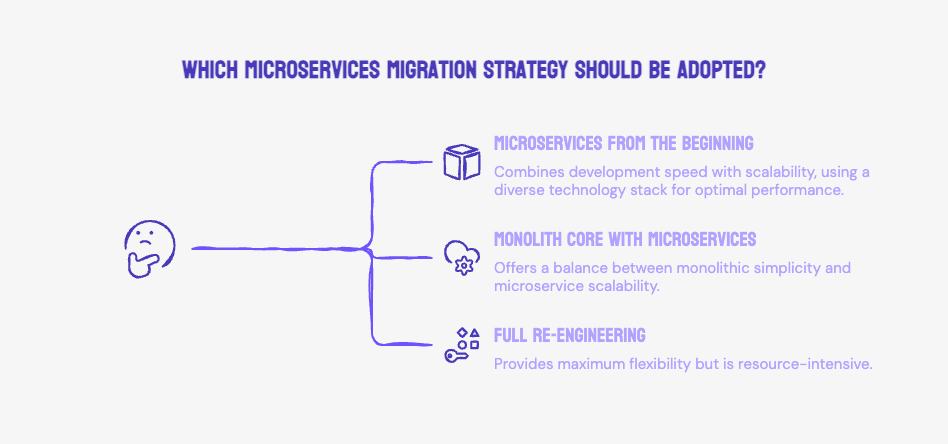
In practice, fintech companies tend to adopt one of three strategies when implementing microservices architecture:
Building microservices from the beginning
Combining a monolithic core with surrounding microservices
Fully re-engineering the system from monolith to microservices
Each strategy has different advantages depending on the maturity of the product and the size of the engineering organization.
Strategy 1: Microservices from the Beginning
Some platforms choose to adopt microservices architecture from the earliest stages of development.
In one wealth management platform example, the system architecture initially consisted primarily of microservices, although certain parts of the system were implemented as monolithic components. As the platform matured, these larger components were gradually split into smaller services based on their responsibilities and maintenance requirements.
This approach allowed the platform to combine the development speed of monolithic applications with the scalability of microservices.
The engineering team used a technology stack that matched the specific needs of each service. Business-related functionality was primarily built using the .NET ecosystem, while computationally intensive components were implemented using C++ to handle optimization and number-crunching tasks.
Other services responsible for data integration were implemented using Python.
This architecture allowed the platform to balance performance, maintainability, and development speed while supporting the growing complexity of financial operations.
Strategy 2: Monolith Core with Microservices Around It
Another common approach is to retain the existing monolithic core while gradually introducing microservices around it.
This strategy is particularly popular among companies with valuable intellectual property embedded in their core system.
Instead of rebuilding the core entirely, the company leaves it intact and builds new functionality as independent microservices.
A distributed enterprise financial platform used this strategy to manage a wide range of products, including financial analytics, portfolio planning tools, and API-based integrations.
The system architecture combined both legacy components and modern microservices. It relied on multiple databases and storage systems, including PostgreSQL, Microsoft SQL Server, Redis, and cloud-based object storage.
Container orchestration played a central role in managing this distributed environment. The platform used container services to deploy and manage independent services in a scalable manner.
According to the engineering leadership, adopting a container-based microservices architecture significantly improved system scalability and helped maintain consistent response times across the platform.
This hybrid approach allowed the organization to gradually evolve its architecture without taking on the risks associated with full system rewrites.
Strategy 3: Full Re-Engineering of the System
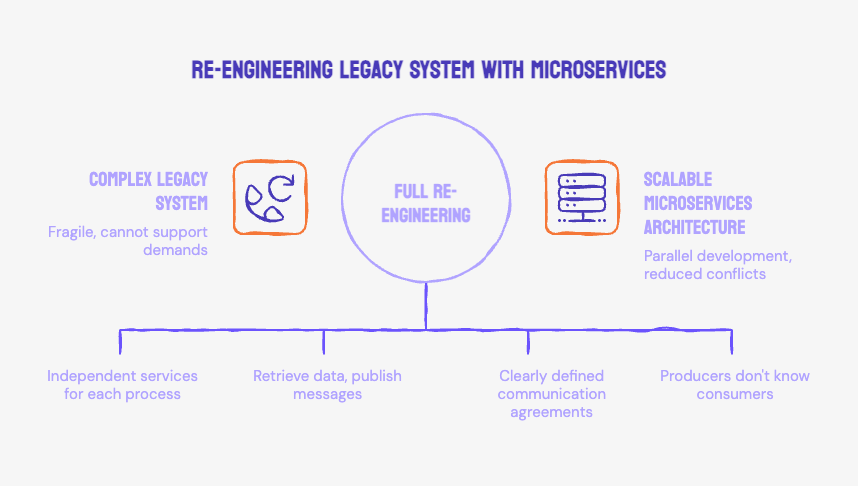
In some cases, legacy systems become too complex or fragile to maintain. When that happens, organizations may decide to fully rebuild the system around microservices.
One wealth automation platform followed this strategy when its original architecture could no longer support the growing product demands.
The engineering team redesigned the system by splitting every business process into independent services.
Each service consisted of two main components:
• a producer that retrieves data and publishes messages to a queue
• a consumer that processes those messages and performs the required operations
These components communicated through clearly defined message contracts.
The producer and consumer services were completely decoupled. Producers did not need to know how consumers processed the data, and consumers did not need to know where the data originated.
This architecture enabled the engineering team to organize development in a highly parallel manner.
The CTO compared the architecture to an assembly line model for software development. Once engineers agreed on data formats and service contracts, multiple teams could build independent services without blocking each other.
This dramatically reduced merge conflicts and enabled dozens of engineers to work on the system simultaneously.
Queue-Based Microservices Architecture
A critical component of this architecture was the use of message queues.
Queues allowed services to exchange data asynchronously while maintaining reliability guarantees.
Messages were stored temporarily in memory-based queue systems, ensuring fast processing and preventing data duplication.
Multiple services could consume messages from the same queue in parallel, allowing the system to scale dynamically.
Another advantage was the ability to increase system capacity instantly.
If a specific service experienced high load, the platform could automatically launch additional container instances to process the queue faster.
This elasticity allowed the platform to maintain consistent performance under fluctuating demand.
Multi-Language Microservices Environment
One of the benefits of microservices architecture is the freedom to choose the best programming language for each service.
In the case of the wealth automation platform, the majority of the system was implemented in Java. However, some lightweight services were written in other languages when appropriate.
For example, one service responsible for determining trading-day schedules was implemented in Go.
This service did not depend on other data sources and only needed to read a configuration file periodically. Implementing it in Go provided a lightweight and efficient solution that integrated seamlessly with the rest of the platform.
Microservices and External Integrations
Financial platforms often need to integrate with multiple custodians, data providers, and trading systems.
Microservices architecture makes it easier to manage these integrations.
In the example platform, the engineering team built an abstraction layer that allowed the system to interact with multiple data partners through specialized services.
When new custodians needed to be integrated, the team could simply add new microservices that handled communication with those providers.
This approach reduced integration time dramatically. New services could often be deployed within months rather than taking a year to implement.
When Microservices Are Not Always the Right Choice
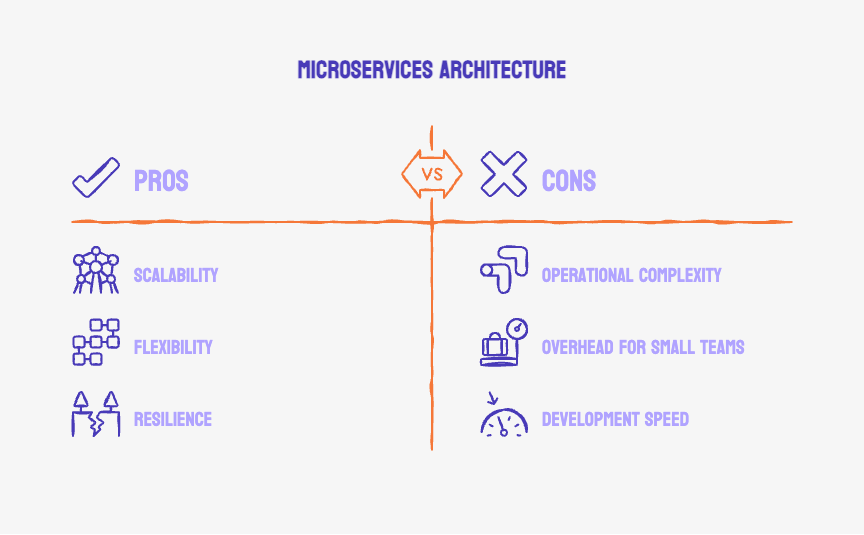
Despite their advantages, microservices are not always the best architecture for every team.
Adopting microservices introduces additional operational complexity. Distributed systems require more infrastructure, monitoring, and coordination between services.
For smaller teams, this overhead may outweigh the benefits.
Engineering leadership at fintech development companies often emphasize that architecture decisions should be driven by team size, product complexity, and business needs.
With small engineering teams, monolithic architectures can actually accelerate development because they reduce infrastructure complexity.
Microservices become more beneficial as organizations scale and need to enable multiple teams to work in parallel.
Key Takeaways
Microservices architecture can significantly improve scalability and development velocity when implemented under the right circumstances.
However, the migration strategy should always be tailored to the organization’s specific situation.
Key lessons from these case studies include:
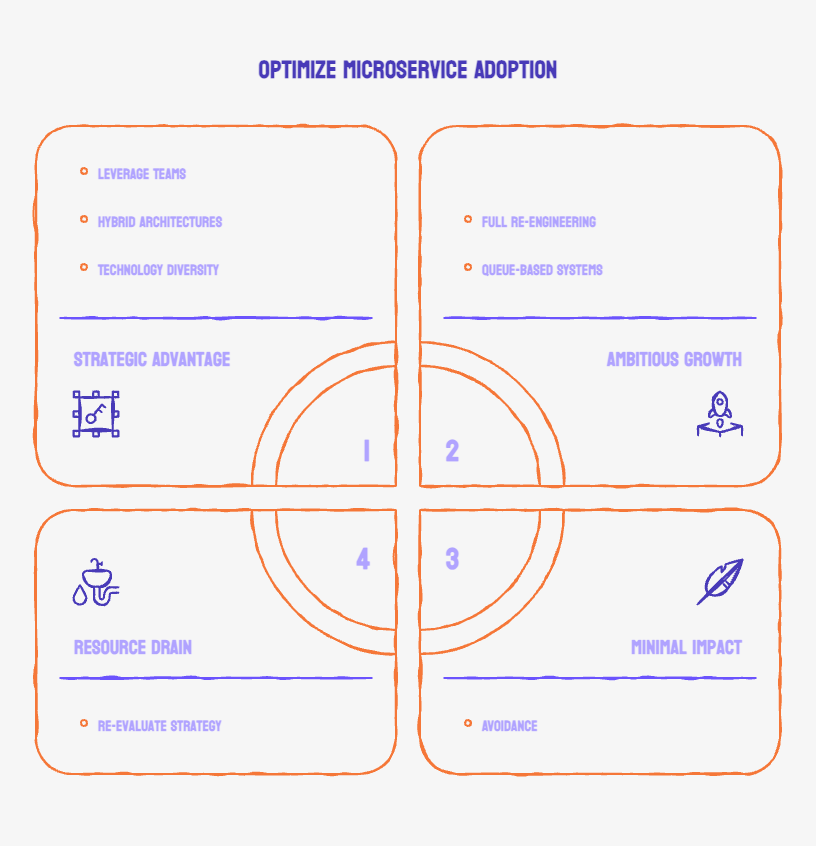
• Microservices are most effective when supporting large engineering teams
• Hybrid architectures allow companies to migrate gradually without rebuilding entire systems
• Queue-based communication enables highly scalable distributed systems
• Microservices enable technology diversity within a single platform
• Architecture decisions should always balance operational complexity with business value
Conclusion
Migrating from a monolithic architecture to microservices is one of the most impactful transformations a financial technology platform can undertake.
When executed strategically, this migration enables companies to scale their systems, accelerate product development, and support larger engineering organizations.
However, microservices are not a one-size-fits-all solution. The success of a migration depends on choosing the right strategy, aligning architecture with team structure, and carefully balancing complexity with scalability.
For fintech platforms operating in rapidly evolving markets, microservices architecture can provide the flexibility and resilience required to sustain long-term growth.