Artificial intelligence is rapidly reshaping financial services, from how platforms process data to how they personalize experiences and manage risk.
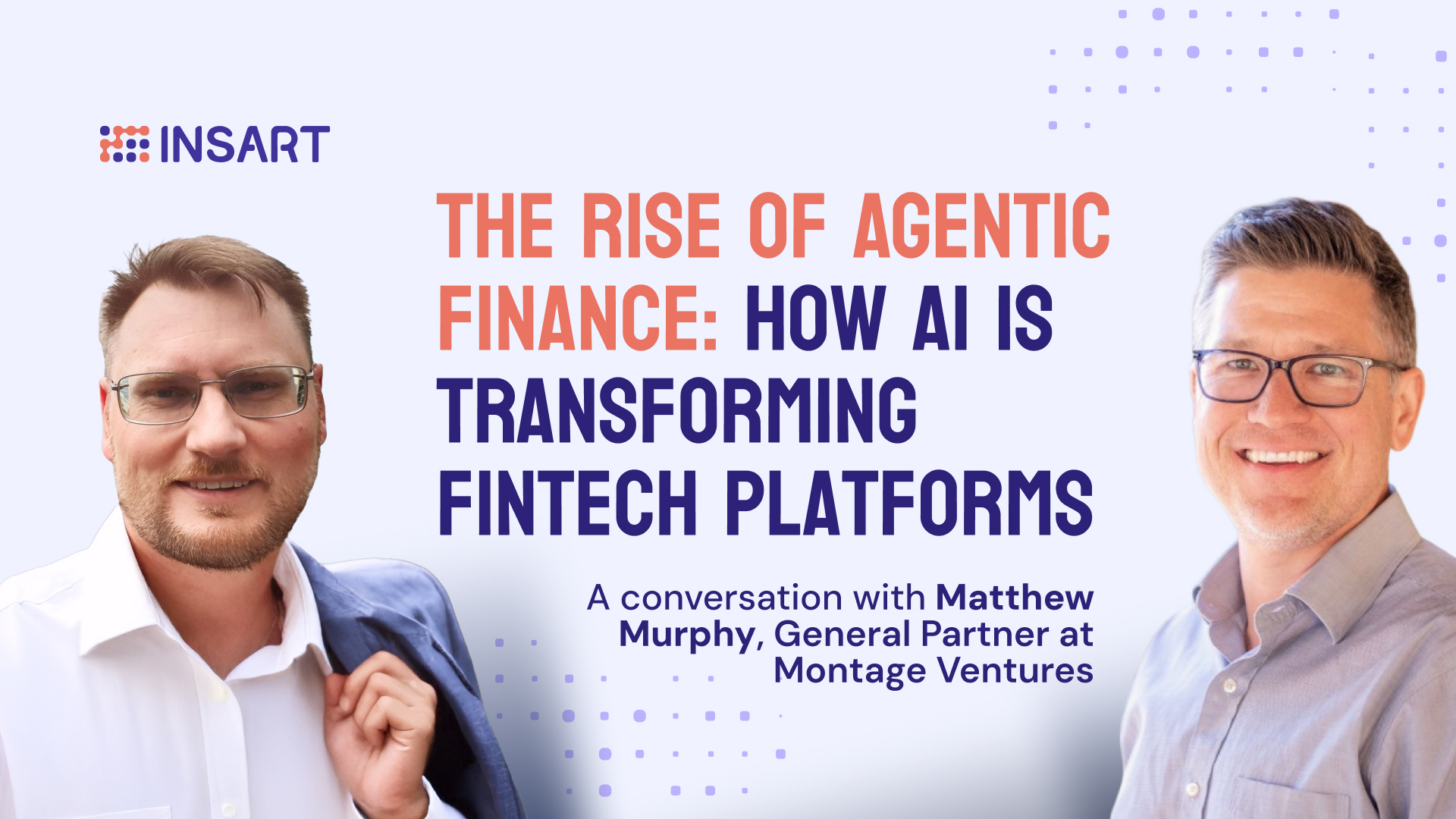
In the latest episode of the Guts, Grit & Fintech Podcast, INSART Fintech Business Accelerator founder Vasyl Soloshchuk sat down with Matthew Murphy, General Partner at Montage Ventures, to explore the rise of agentic finance — a new paradigm where AI agents execute workflows across fintech organizations.
Murphy brings a unique perspective. Before becoming an investor, he spent years as an operator, founder, and marketing leader, contributing to the growth of companies like Chime Technologies, and witnessing major fintech exits including SoFi and FiscalNote.
Their conversation dives into how AI agents are reshaping financial operations, how investors evaluate early-stage founders in the AI era, and why regulatory awareness is becoming a competitive advantage for fintech startups. Below are highlights from the discussion.
From Founder to Fintech Investor
Vasyl Soloshchuk:
Matthew, you’ve had an impressive journey: from operator and entrepreneur to venture investor. What are you focused on today?
Matthew Murphy:
Today I’m a General Partner at Montage Ventures. The firm was founded about eleven years ago with a simple but powerful mission: maximize founders’ ambition.
We invest in startups transforming three major sectors: financial services, healthcare, and commerce. Together, those industries represent more than half of U.S. GDP, so we believe they’re prime for disruption.
What makes Montage unique is that our team is made up of former founders and operators. We’ve built and scaled companies ourselves, so we bring not only capital but relationships, experience, and operational insight.
Typically, we write initial checks between $1M and $3M. But honestly, the capital is often the least valuable thing we provide. Our goal is to act as the closest thing to a co-founder outside the company, helping with hiring, early customer introductions, and building long-term fundraising strategies.
What Is Agentic Finance?
Vasyl Soloshchuk:
Montage Ventures has been focusing on agentic finance. For those new to the term, what exactly does it mean?
Matthew Murphy:
AI is creating a massive transformation across the entire technology landscape.
When we talk about agentic finance, we’re referring to how AI agents are reshaping financial services. These agents can perform tasks, execute workflows, and support decision-making across financial organizations.
For example, companies are using AI agents to:
- Process large volumes of financial data
- Automate document intake and analysis
- Support underwriting and risk evaluation
- Assist customer service teams
- Streamline reporting and internal workflows
AI agents can ingest data, clean it, analyze it using internal models, and then deliver actionable insights to teams across the company, from finance and operations to marketing and sales.
Why AI Agents Are So Powerful
Vasyl Soloshchuk:
At INSART’s fintech accelerator, we’ve been seeing similar patterns, especially around reporting automation. With generative AI, teams can generate financial reports dynamically instead of building rigid templates.
Matthew Murphy:
Exactly. Whenever you have a clear, repeatable workflow, an AI agent can handle that process extremely well.
Take loan underwriting as an example. Traditionally, underwriting requires gathering multiple documents: income statements, bank records, and other financial data.
An AI agent can:
- Collect the necessary documents from customers
- Analyze them against underwriting criteria
- Communicate with customers to request missing information
- Generate recommendations on loan approval and terms
What’s important is that these systems don’t replace people, at least not today. Instead, they supercharge teams, allowing companies to process dramatically more information and operate much faster.
We’re seeing some portfolio companies effectively 10x their operational output using AI agents.
How an Operator’s Mindset Helps in Venture Investing
Vasyl Soloshchuk:
You spent years as an operator before becoming an investor. How does that experience shape how you evaluate startups?
Matthew Murphy:
At the seed stage, you’re often investing in two founders, a presentation, and a big idea, sometimes before there’s even a product. My operating experience helps me with pattern recognition. When evaluating founders, I’m thinking about:
- Can they actually execute on this vision?
- Are market conditions creating tailwinds or headwinds?
- Is the technology advantage real?
- Is the market ready for the level of innovation they’re proposing?
Sometimes founders are one step ahead of the market, which is great. But sometimes they’re five steps ahead, which can make timing incredibly difficult. Ultimately, venture investing at the early stage is about betting on people.
Why Investors Often Bet on Founders, Not Products
Vasyl Soloshchuk:
Some investors prefer to wait for traction and metrics before investing. But you often invest earlier. How do you build conviction that early?
Matthew Murphy:
One lesson I’ve learned after nearly 15 years in venture is this:
The product almost always changes.
Nine times out of ten, the company that succeeds looks very different from the original pitch. Because of that, what really matters is the founder’s ability to adapt, iterate, and keep building. You’re going to be working with those founders for 8 to 10 years. You might not be working with that initial product for nearly that long. The biggest mistake investors make is falling in love with the product instead of the founders.
Positive and Negative Signals in Early-Stage Founders
Vasyl Soloshchuk:
Are there signals that help you identify promising founders early on?
Matthew Murphy:
One of the strongest signals is consistency between what founders say and what they actually deliver. For example, if a founder tells us:
“We’ll reach 25 customers and $1M in revenue within nine months.”
And six months later they’ve hit (or exceeded) that milestone, that’s a very strong signal. On the other hand, if they fall dramatically short of their own projections, it raises questions about execution or market understanding.
Ideally, we like to meet founders before they’re fundraising, when they’re still building. That allows us to help with introductions, strategy, and product direction while getting to know them over time. Sometimes that leads to pre-emptive investments before a formal fundraising round.
The Regulatory Reality of Fintech Innovation
Vasyl Soloshchuk:
Agentic finance also introduces regulatory and operational challenges. How should founders balance innovation and compliance?
Matthew Murphy:
Financial services is a regulated industry, and founders need to respect that. In fintech, ignoring regulation isn’t just risky for the business. In some cases, it can lead to legal consequences. That’s why I have tremendous respect for founders who don’t just follow regulations but help shape them.
Take stablecoins, for example. For years they operated in a regulatory gray area in the U.S. Recently we’ve seen clearer guidance emerge, which gives founders much more confidence about where the boundaries are.
The Biggest AI Risk in Financial Services
Vasyl Soloshchuk:
What risks should founders consider when deploying AI agents in financial services?
Matthew Murphy:
The biggest issue today is that AI systems still require human oversight. AI agents shouldn’t operate completely independently when they’re handling sensitive financial data. Founders need to ensure:
- Data privacy and security are maintained
- Systems remain compliant with standards like SOC 2
- Human approval exists for critical decisions
We’re also still early in the evolution of large language models.
I once heard Kevin Weil from OpenAI say something interesting:
“The models we use today are the worst we’ll ever use for the rest of our lives.”
The pace of improvement is incredibly fast. But in regulated industries like finance, innovation must move alongside compliance.
How AI Is Changing Venture Capital Itself
Vasyl Soloshchuk:
How are you personally using AI tools inside your venture firm?
Matthew Murphy:
We started by identifying five simple internal problems we wanted AI to solve. One example: we want to discover great founders the moment they start building something new.
So we built internal AI systems that monitor signals such as:
- Founders entering stealth mode
- Startup incorporations
- Product leaders leaving major companies to start something new
When those signals appear, our system alerts us so we can reach out immediately and start building a relationship. We encourage our portfolio companies to do the same — start with clear internal problems and build AI agents to solve them. That’s something that simply wasn’t possible 12–24 months ago.
The Future of Agentic Finance
AI agents are quickly becoming the operational backbone of modern fintech platforms.
From underwriting automation to compliance workflows and founder discovery tools, agentic systems are reshaping how financial services companies operate, often delivering massive efficiency gains.
But as Murphy emphasizes, success in this new era will require more than just AI expertise. Founders must combine technical innovation, regulatory awareness, and relentless execution. Because in venture capital, as in fintech, the biggest bets are still placed on people.