How to modernize a mission-critical Django system without interrupting financial operations
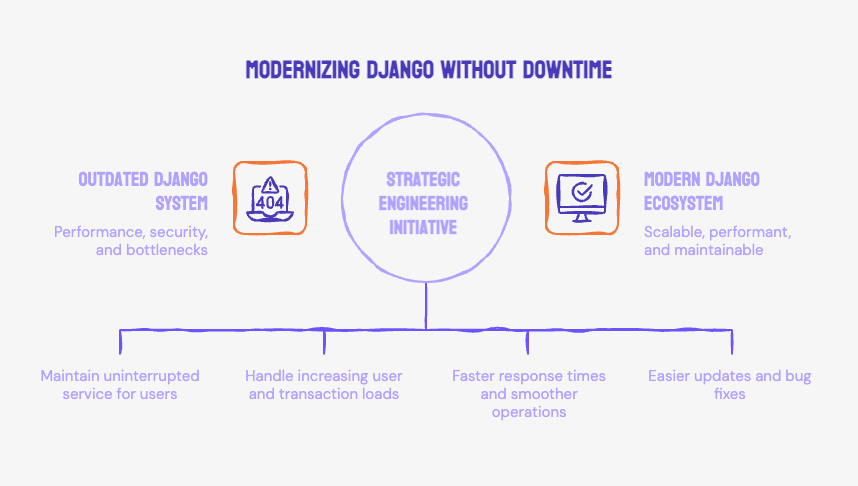
Financial products rarely have the luxury of downtime. Platforms handling transactions, user portfolios, payments, and compliance workflows must remain stable while continuously evolving. As these products grow, their technology stack often becomes outdated, creating performance limitations, security risks, and development bottlenecks.
Modernizing a large Django application is therefore not simply a technical upgrade. It is a strategic engineering initiative designed to preserve operational stability while improving scalability, performance, and long-term maintainability.
This case study describes how a high-load financial platform successfully migrated its backend architecture from an outdated Django stack to a modern Django ecosystem while maintaining uninterrupted service for thousands of active users.
The Challenge
The platform in question had been operating for several years and was built on an early Django version combined with multiple legacy dependencies.
The system supported:
• Real-time financial transactions
• Portfolio management features
• Multiple external banking integrations
• Compliance and audit workflows
• High-volume API requests from mobile and web applications
Over time, the platform began experiencing several structural issues.
First, the framework version had fallen far behind the supported Django releases. The application was running on Django 2.x, while the ecosystem had already matured significantly with Django 4.x and 5.x.
Second, several third-party dependencies had become outdated or unsupported, introducing potential security vulnerabilities.
Third, the monolithic architecture made development slower and increased the risk of introducing bugs during deployments.
Finally, performance bottlenecks appeared as the user base grew. Some API endpoints handling financial data queries became significantly slower under heavy load.
The engineering leadership recognized that postponing modernization would only increase the risks and complexity of future migrations.
Migration Goals
The migration initiative focused on several strategic objectives.
- Maintain uninterrupted financial operations
- The platform handled sensitive financial data and transactions. Downtime during migration was not acceptable.
- Upgrade the core backend framework
- The application needed to migrate to a supported Django version to benefit from security updates and modern features.
- Improve performance under heavy traffic
- The platform needed to scale reliably as the number of users and integrations increased.
- Strengthen system security and compliance readiness
- Modern Django versions include improvements in security mechanisms essential for financial products.
- Modernize the development architecture
- The engineering team wanted to introduce clearer module boundaries, improved API structure, and modern infrastructure tooling.
Migration Strategy
Instead of attempting a risky full rewrite, the team implemented a phased migration strategy.
This approach focused on gradually upgrading the platform while maintaining continuous production availability.
The migration was divided into five major stages:
System audit and architecture assessment
Dependency modernization
Incremental Django framework upgrade
Infrastructure and performance improvements
Production rollout and stabilization

Stage 1: System Audit and Architecture Assessment
Before touching the codebase, the team conducted a comprehensive system audit.
The goal was to understand how the existing application behaved in production and identify potential migration blockers.
The audit focused on several areas:
Codebase structure
The team mapped the architecture of the application, identifying tightly coupled modules and legacy design patterns.
Financial platforms often accumulate years of incremental development. In this case, several modules had overlapping responsibilities, which would complicate migration.
Dependency inventory
The team analyzed all Python dependencies listed in the requirements files and evaluated compatibility with modern Django versions.
Several libraries used for authentication, background tasks, and database management required upgrades or replacements.
Database structure
Financial applications often maintain large relational databases with strict data integrity rules.
The team carefully reviewed database migrations, indexing strategies, and query performance patterns to ensure compatibility with modern ORM behavior.
Infrastructure dependencies
The audit also examined infrastructure elements such as:
• task queues
• caching systems
• containerization setup
• monitoring tools
• deployment pipelines
Understanding the infrastructure stack allowed the team to design a migration plan that would not disrupt existing production workflows.
Stage 2: Dependency Modernization
Once the audit was complete, the team began modernizing the dependency stack.
This stage focused on preparing the environment for framework upgrades without changing business logic.
Key upgrades included:
- Python runtime upgrade
- The application was migrated to a modern Python version to ensure compatibility with current Django releases.
- Task processing modernization
- Legacy task queue configurations were upgraded to modern Celery versions combined with Redis for improved reliability.
- Authentication libraries
- Security libraries responsible for token handling and session management were updated to supported versions.
- API framework alignment
- The platform relied heavily on REST APIs for mobile applications. The team upgraded the Django REST Framework to a modern release compatible with the target Django version.
Each dependency upgrade was tested in isolation to prevent cascading failures.
Stage 3: Incremental Django Upgrade
The core framework upgrade was performed incrementally.
Attempting to jump directly from an early Django version to the latest release would introduce too many breaking changes.
Instead, the team followed Django’s recommended upgrade path:
Django 2.x → Django 3.2 → Django 4.2 → Django 5.x
Each step included:
• updating compatibility warnings
• adjusting deprecated API usage
• fixing middleware changes
• validating ORM behavior
Extensive automated tests were critical during this stage.
Strengthening the Test Environment
Before upgrading the framework, the team significantly expanded test coverage.
Financial platforms require extremely reliable behavior when processing transactions.
The testing strategy included:
• unit tests for critical business logic
• integration tests for payment flows
• API contract tests for mobile applications
• database migration validation tests
This testing layer ensured that framework upgrades did not break financial workflows.
Stage 4: Architecture Improvements
With the framework upgraded, the team focused on architectural improvements to support future scaling.
Modularization
The monolithic Django project was reorganized into clearer application modules.
This reduced interdependencies and improved maintainability.
Asynchronous processing
Several heavy operations were moved to background workers using Celery.
This reduced API latency for financial operations such as transaction processing and reporting.
Database optimization
High-load queries were optimized using:
• improved indexing
• query restructuring
• caching strategies
API performance improvements
The API layer was optimized using:
• pagination improvements
• query optimization
• caching frequently requested financial data
These improvements significantly reduced response times for high-traffic endpoints.

Stage 5: Production Rollout
The final stage focused on deploying the upgraded system safely.
Blue-Green Deployment
The team implemented a blue-green deployment strategy.
This allowed the new system version to run alongside the existing production environment until stability was verified.
Gradual traffic shifting
Traffic was gradually redirected to the new system while monitoring performance and error rates.
Monitoring and observability
Enhanced monitoring dashboards were implemented to track:
- API latency
- transaction processing time
- database load
- system error rates
This visibility allowed engineers to quickly identify and address potential issues.

Results
The migration delivered measurable improvements across the platform.
- Performance improvements
- Several API endpoints handling financial queries saw response time improvements of up to 40%.
- Improved system stability
- Upgrading dependencies eliminated several long-standing bugs caused by outdated libraries.
- Enhanced security
- The platform benefited from modern Django security features and updated authentication mechanisms.
- Improved developer productivity
- Developers were able to introduce new features faster due to clearer architecture and modern tooling.
- Future-ready infrastructure
- The platform now runs on a modern Django stack capable of supporting future scaling and feature development.
Key Lessons
Several insights emerged from the migration project.
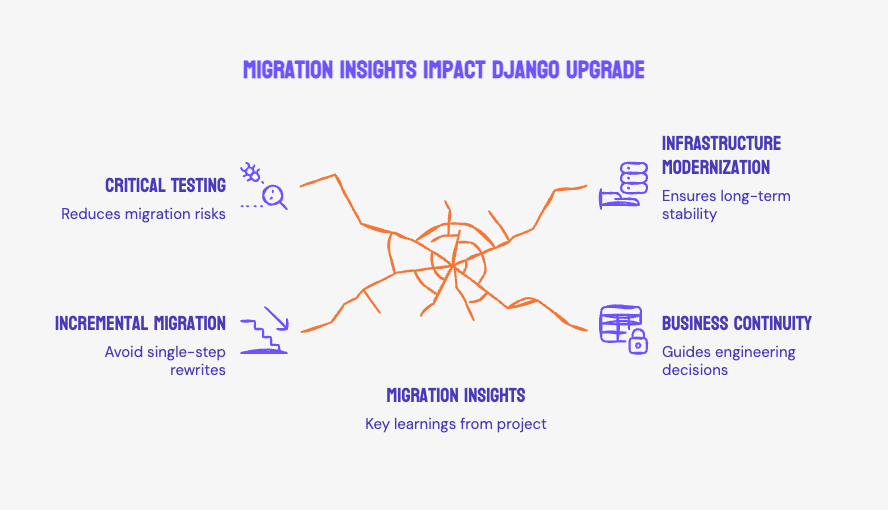
- Migration should be incremental
- Large systems should never attempt framework rewrites in a single step.
- Testing is critical
- Strong automated testing significantly reduces migration risks.
- Infrastructure matters as much as code
- Modernizing infrastructure alongside the framework ensures long-term stability.
- Business continuity must guide engineering decisions
- For financial platforms, uninterrupted service is the primary constraint shaping migration strategy.
Conclusion
Migrating a large Django application within a financial product environment requires careful planning, incremental execution, and strong observability.
When executed properly, migration becomes an opportunity to improve architecture, performance, and security without sacrificing operational stability.
For high-load financial platforms, modernization is not simply a technical upgrade. It is a strategic investment that ensures the product can continue evolving in a rapidly changing technology ecosystem.