
When the founders of a rapidly growing operational intelligence startup approached INSART, they explained a challenge familiar to many young companies: the product was evolving faster than the technology beneath it. Their web platform had become the center of daily operations for hundreds of distributed field workers. It offered sophisticated tools for orchestrating workflows across multiple sites, generating AI-driven procedural recommendations, tracking real-time activity, and maintaining strict operational compliance. But their mobile application—supposed to be the lifeline for employees in the field—was a thin companion product that mirrored almost none of the web’s intelligence.
The web app had matured into a powerful command center. The mobile app was an afterthought.
This mismatch created a growing operational divide. While office teams used the web dashboard to coordinate complex procedures and monitor field progress minute by minute, the workers actually performing the tasks relied on simplified mobile screens that lacked context, guidance, and AI support. As the organization scaled, the consequences of this split became increasingly visible: misalignments in execution, delays caused by poor real-time communication, avoidable compliance breaches, and a general lack of confidence in the system’s reliability outside the office.
The company needed a mobile platform as powerful as their web one—something that could support complex workflows, deliver real-time decision support, provide intelligent guidance, and remain stable in environments with weak connectivity. And they needed this without rewriting their existing backend, which was a deeply integrated system built on a Go-based REST API, PostgreSQL, and a collection of specialized microservices powering geolocation, AI summarization, and compliance audit pipelines.
INSART was brought in to close this gap.
Reimagining the Mobile Experience
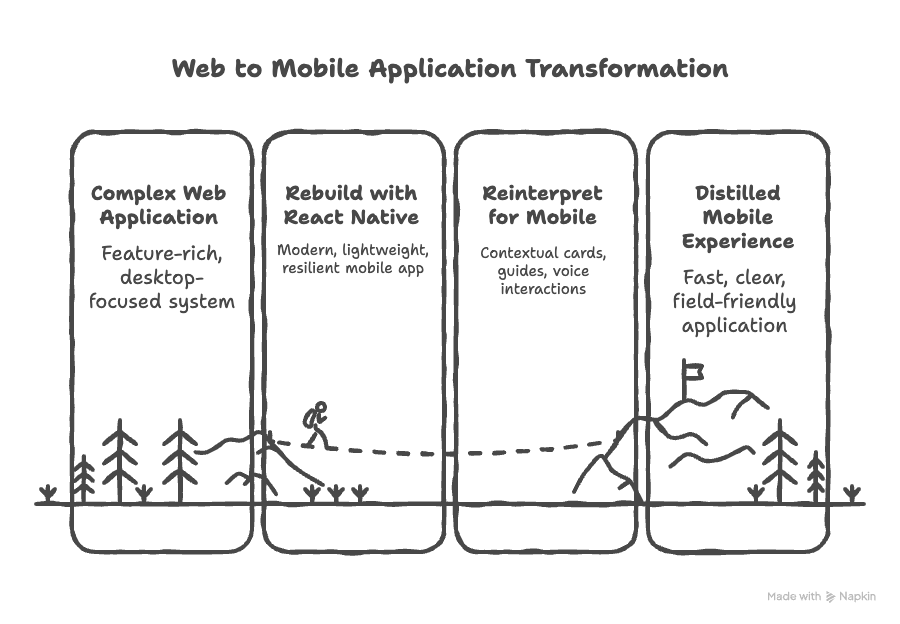
Our first task was understanding the depth of the existing system. The web application was years ahead in terms of functionality. It included a workflow builder capable of expressing multi-step operational procedures, a rich activity log that tracked every action across teams, an AI layer that generated summaries and recommendations, and a geolocation engine able to interpret movements across job sites. All of this had to transition into an entirely different user environment—one defined by quick interactions, unpredictable network conditions, and the need for absolute clarity during active field work.
We rebuilt the mobile application from the ground up using React Native with Expo, adopting a modern, lightweight state management approach through Zustand. This ensured the application felt fast, reactive, and resilient, especially when workers moved between high-signal and offline environments. Every major capability of the web app—from workflow execution to event logging—was reinterpreted for mobile ergonomics. Instead of dense grids and tables, data became contextual cards, step-by-step guides, progressive forms, and voice-friendly interactions.
Rather than duplicating the web experience, we distilled it.
Bringing AI Into Workers’ Pockets
One of the most transformative pieces of the project was the integration of a conversational AI assistant directly into the mobile experience. Previously, AI was hidden inside the web application, mostly invoked to generate summaries of completed work or produce compliance documentation. But the field workers—the people who needed guidance in real time—had no access to it.
INSART turned the AI into a companion. It became the first screen many workers opened at the job site each morning. They could ask it how to complete a procedure, clarify a step in a workflow, review yesterday’s performance, or dictate voice notes that the assistant instantly converted into structured data. Because OpenAI’s models were already integrated into the backend—similar to how SERA leverages AI—the implementation required deep respect for existing backend conventions while enabling much richer front-end interactions.
The assistant remembered context across conversations, learned workers’ preferences, adapted its explanations based on past behavior, and always stayed within strict compliance boundaries defined by the client. It guided, nudged, summarized, warned, and encouraged—becoming, in a very real sense, part of the team.
Mobile-Native Geolocation and Compliance
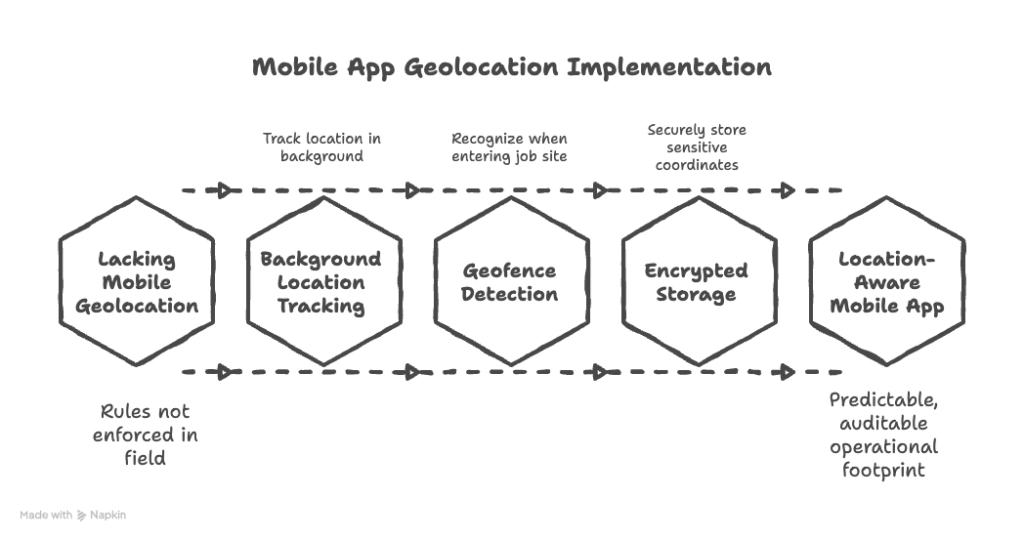
One of the most technically complex parts of the project involved building a robust geolocation layer directly into the mobile app. The web platform had long tracked operational zones, restricted areas, and task-based geofences. But without geolocation capabilities on mobile, none of those rules could be enforced in the field.
INSART introduced background location tracking, geofence detection, and encrypted storage of sensitive coordinates. The system could recognize when workers entered a job site, automatically present the appropriate workflows, warn them when they approached restricted zones, or prompt them to record certain actions based on where they were standing. The app became a location-aware assistant that blended human judgment with automated guardrails.
This context-awareness dramatically reduced procedural errors and created a more predictable, auditable operational footprint.
Real-Time Visibility Through Push Notifications
The original mobile app functioned largely in isolation. Field workers only saw information if they manually refreshed screens or returned to the web app. This created delays exactly where immediacy mattered most.
We implemented a complete push notification infrastructure using Expo Notifications, tightly integrated with the client’s Go backend. Changes in task assignments, sudden safety alerts, workflow adjustments, and AI-generated insights were delivered the moment they occurred. Workers could customize their notification preferences, define quiet hours, and choose how the app should behave during critical incidents. Notifications were not treated as an afterthought—they became an operational communication channel.
Predictive Models for Operational Efficiency
Although the domain was different from financial forecasting, the client still needed predictive intelligence—models that could anticipate problems, estimate delays, evaluate workflow complexity, and identify patterns in operational failures. INSART built a predictive engine that learned from past execution data, monitored current field activity, and assessed risk in real time.
The mobile application integrated this intelligence into daily activities. Workers could see which tasks were likely to run long, where bottlenecks were forming, and when it made sense to reorder their workflow. Supervisors could review probabilistic outcomes and intervene before small issues escalated.
The app evolved from a passive tool into a forward-looking operational partner.
A Unified Design System for Speed and Consistency
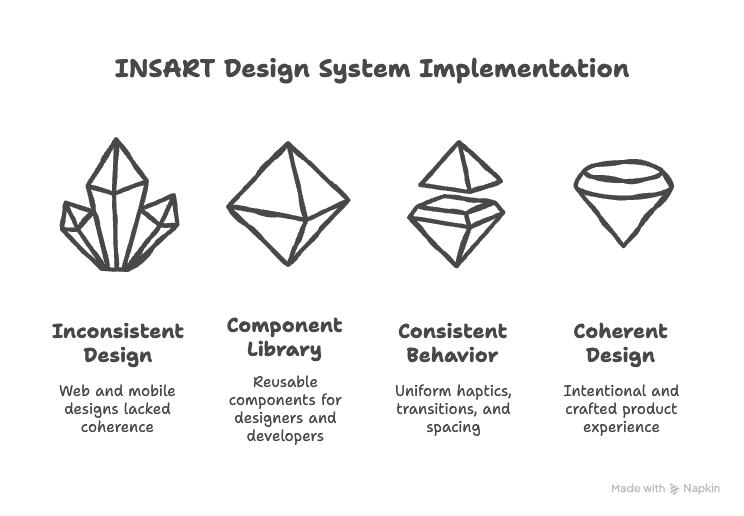
To maintain coherence across both web and mobile, INSART introduced a design system built upon ShadCN UI primitives, Radix patterns, and Tailwind tokens. Each component—buttons, list items, cards, modals, and interactive elements—became part of a reusable library accessible to designers and developers across the organization.
This system ensured consistency not just in appearance but in behavior: consistent haptics, predictable transitions, uniform spacing, accessible color contrast, and a layout language that made the entire product feel intentional and crafted.
The design system accelerated development velocity and eliminated inconsistencies that had accumulated over years of rapid iteration.
The Impact
Within six months, the client’s mobile application matched the web platform in functional depth while surpassing it in usability for field operations. Workers experienced a dramatic improvement in clarity, speed, and access to guidance. Supervisors reported fewer procedural errors, faster execution times, and richer audit trails. AI-assisted conversations reduced training overhead and helped workers complete tasks more accurately. Geolocation-based automation created a more predictable operational flow. Push notifications closed communication gaps. The predictive models improved planning and reduced operational surprises.
The new mobile app became not just a tool but a central part of the company’s identity—a reflection of its ambition to bring intelligence, efficiency, and clarity to every layer of operations.