
$608K overcharged · $500K returned or credited · experience mod corrected from 1.21 to 1.06 · in 7 months
The renewal letter
It came in March, the same week as a big bid deadline.
The company is a family-owned steel fabricator and erector. It has about 240 employees and a shop in Tennessee. It runs field crews on jobs across Tennessee, Georgia and Alabama. Workers’ comp was already its second-largest insurance cost, at about $1.3M a year.
The renewal showed a new experience mod of 1.21, up from 0.94 the year before. The rates hadn’t changed and nobody had been badly hurt. But the mod alone added about $370,000 to next year’s premium. On a business that earns 6–8 cents on each dollar of revenue, that was roughly the profit on a mid-size job, gone before the year started.
The CFO asked the broker why. The answer was the usual one. The mod comes from three years of payroll and claims, it is calculated by the rating bureau (NCCI), and it is what it is. The only option was better safety and waiting three years for the bad years to roll off.
The CFO wasn’t convinced. Over the years the company had paid every audit bill without arguing, because nobody had time to check them. So she decided to have them checked.
A box of paperwork nobody had read together
To check a workers’ comp premium, you need documents that live in five different places:
- Premium audits for the last three policy years: the carrier’s worksheets, from the finance inbox
- Experience rating worksheets for the current and prior mods, from the broker
- Loss runs listing every claim and its reserve, from the carrier portal
- Payroll registers, from the payroll provider
- Time-clock exports with hours by job and task code, from the field app
- Subcontractor certificates of insurance, scattered across project managers’ email
Together that was about 9,000 pages and files. Each document was correct on its own. The money was in the gaps between them, which no person had ever had time to cross-check.
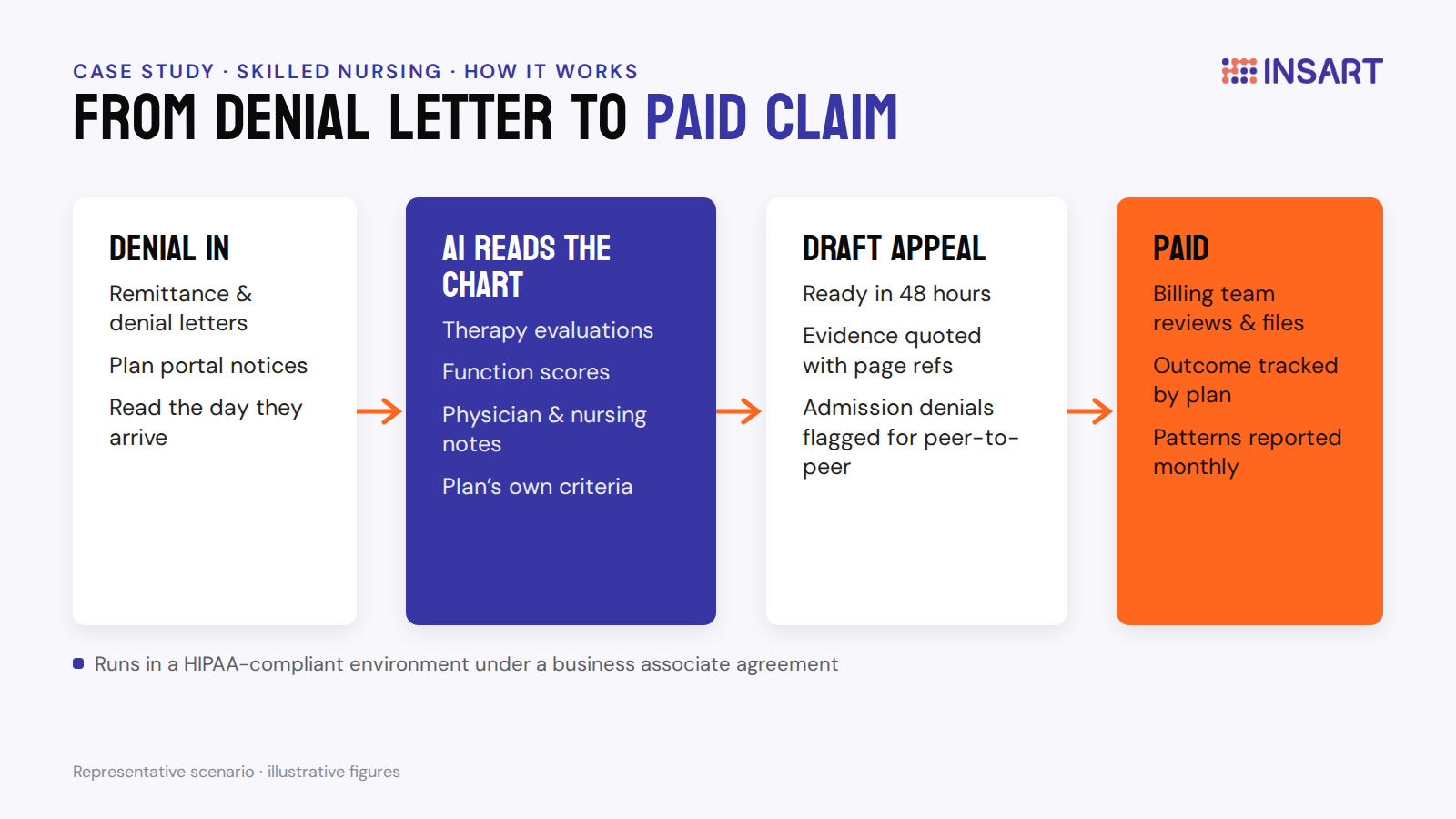
INSART’s AI read all of it in a secure environment and matched every line of every audit against the payroll, hours, claims and certificates behind it. It took six weeks, and it turned up four separate problems.
Finding 1: Shop welders billed as ironworkers
Steel work in a shop and steel work on a construction site carry very different workers’ comp rates. Shop fabrication (NCCI code 3040) costs a fraction of steel erection on site (code 5040).
About 30 of the company’s welders worked mostly in the shop and went out to sites now and then. The time-clock system tracked this well: every shift was tagged “shop” or “field”. But the payroll register showed one line per person, with no split.
NCCI rules allow a construction employer to split one worker’s pay between class codes, but only if its records show the hours worked under each. The auditor saw only the payroll register. With no split visible, every dollar those welders earned went to the most expensive code.
The AI rebuilt the split for three years of shifts. On average, 71% of those hours were shop hours.
Overcharge: $284,000 across three audits. The carrier re-audited the two most recent policy years and refunded $191,000. The oldest year was past the window its policy allowed for changes.
Finding 2: Overtime counted at full value
In most states, the extra “half” of time-and-a-half pay is left out of the payroll that workers’ comp premium is charged on. You pay premium on the regular rate for overtime hours, not on the premium part.
Field crews worked long weeks in summer. The payroll provider’s audit report showed total wages, with overtime pay all in one number. The auditor charged premium on all of it.
Overcharge: $46,000 over three years. Recovered: $31,000 from the two years still open.
Finding 3: Subcontractors who were insured all along
When a contractor hires a subcontractor without proof that the sub has its own workers’ comp, the carrier adds that sub’s cost to the contractor’s payroll and charges premium on it. This is normal, because the contractor could be liable if one of the sub’s workers gets hurt.
Seven subcontractors were charged this way. All seven had valid insurance. Their certificates were sitting in project managers’ email and had never been sent to the auditor.
The AI matched each certificate to the right sub, the right job and the policy dates.
Overcharge: $72,000. Recovered: all $72,000, because every charge fell in the two open years.
Finding 4: The mod itself was built on bad data
This was the biggest one.
The mod compares a company’s actual claims with the claims NCCI would expect for a company of its size and type. Higher payroll means NCCI expects more claims. More actual claims push the mod up. The AI rebuilt the 1.21 mod line by line from the NCCI worksheet and found three errors in what the carrier had reported:
- A claim from the wrong company. One claim belonged to a sister company that does equipment rental under its own tax ID. It had been reported under the fabricator’s policy.
- A medical-only claim reported as lost time. A worker had a cut treated at urgent care and missed no work. In most states, medical-only claims count at just 30% in the mod calculation. Because this one was coded as lost time, it counted at 100%.
- One year’s payroll reported too low. About $1.1M of payroll was missing from one year’s report to NCCI. Lower payroll means fewer expected claims, which pushes the mod up.
There is one rule worth knowing here. A claim that later settles for less than it was valued at does not change an existing mod. But data that was reported wrong can be corrected, and then the mod is recalculated.
The broker sent the evidence to the carrier. The carrier filed corrected reports with NCCI, and NCCI issued a revised mod: 1.06.
Premium reduction on the current policy: $206,000. The fixes also carry into the next two years, because those same policy years stay in the mod calculation.
How the case was made
None of this needed a lawyer or a fight. Each finding went out as a short packet:
- what was billed
- what the rule says
- the records that prove it
- the dollar amount
The broker filed every packet. That mattered. Brokers are often the gatekeepers on workers’ comp, and they don’t like outsiders who make them look bad. This broker got a client keeping a $370K increase that it didn’t deserve. The broker presented the result to the client as its own win, and was right to.
| When | What happened |
|---|---|
| Weeks 1–6 | Documents collected, AI review, findings checked by the finance team |
| Week 7 | Packets sent to the broker, then on to the carrier |
| Weeks 9–14 | Carrier re-audit of two policy years, refunds issued |
| Weeks 10–24 | Corrected reports filed with NCCI, revised mod issued, policy re-rated |
What runs now, every month
The look-back found money. The ongoing process keeps it from leaking again:
- Every payroll period: hours are tagged to the right class code using time-clock task codes, so the split exists before the auditor asks for it.
- Before each audit: an audit-ready packet with payroll by class, overtime premium shown separately, and every sub’s certificate attached.
- Every quarter: claim reserves and claim types are checked against what the carrier reports, so coding errors are caught before NCCI uses them.
- 60 days before renewal: the AI forecasts the next mod from the data, so there are no surprises.
The forecast for the next renewal is 0.98.
The numbers
| Finding | Overcharged | Returned or credited |
|---|---|---|
| Shop welders billed at the erection rate | $284K | $191K |
| Overtime counted at full value | $46K | $31K |
| Insured subs charged as uninsured | $72K | $72K |
| Mod built on bad data (current policy) | $206K | $206K |
| Total | $608K | $500K |
Could this be in your premium?
These are the signs:
- crews whose work spans more than one class code
- a lot of overtime
- subcontractors on most jobs
- a mod that jumped without a matching jump in serious injuries
- audit bills that were paid without being checked
To find out, you need three years of premium audits, your current mod worksheet, loss runs, and payroll and time-clock exports. A first review takes about four weeks.