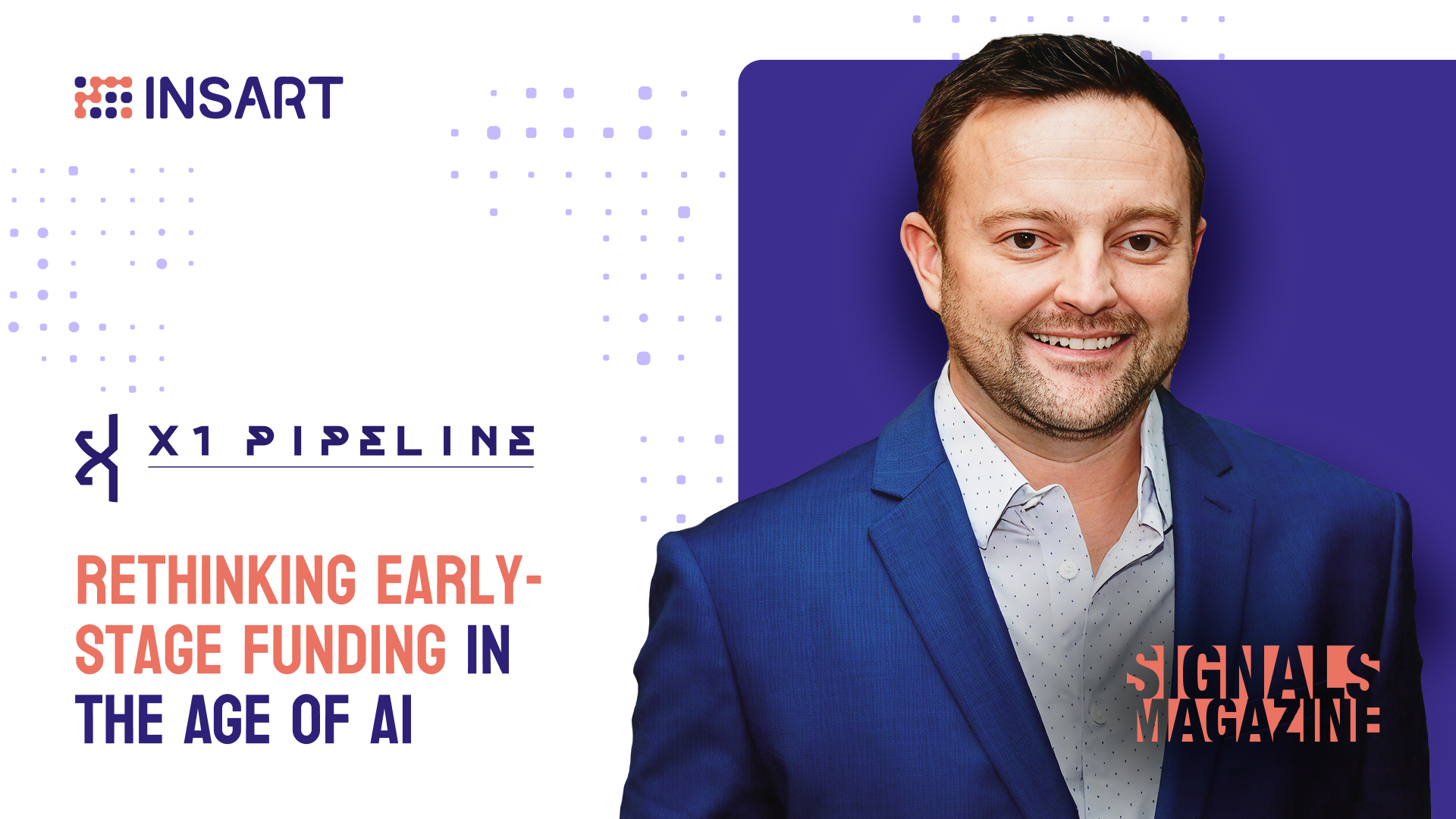

Early-stage fundraising has long been a paradox: founders pour countless hours into pitch decks and investor meetings rather than their actual product, while investors wade through an avalanche of decks searching for the rare deal worth their attention. In a recent conversation, Christopher Coomes — entrepreneur, investor, and builder of X1 Pipeline — unpacked why the system is broken and how AI is reshaping it. From eliminating pitch decks to redefining “investability,” his perspective offers a glimpse into what fundraising could (and likely will) become.
The Broken Reality of Early-Stage Fundraising
Ask most founders what fundraising feels like, and the word that comes up most often isn’t “exciting.” It’s “exhausting.”
Christopher explains why. The inefficiencies compound from the very first step. “Most of the inefficiency for founders,” he explains, “is that they have to create pitch decks and reframe things, constantly building documentation for investors instead of building a company.” That documentation burden alone would be manageable if it led somewhere productive. But it rarely does, because the deeper problem is structural: most founders simply don’t have an investor network to begin with.
Take a founder building an ed-tech startup. They likely know educators, product people, maybe a few operators, but not the specific subset of investors who have both the appetite and the thesis to back her. So they build a list from scratch, research funds, craft outreach, and fire into the dark. “You have to try to contact all of them,” Christopher says, “and 90% of them aren’t people who would invest in you anyway. So you’re wasting 90% of your time contacting people who don’t really have a future with you.”
Investors, for all the power they hold in this dynamic, are equally trapped by this process. Pitch decks arrive formatted inconsistently, with missing information, demanding research that most investors simply don’t have time to do. “If you really want to look at a company,” Coomes notes, “you need at least three hours per company, and nobody’s going to do that.” Instead, a decision gets made in ninety seconds: Am I going to look more, or not?
What’s striking about Christopher’s framing is that he refuses to assign blame. He’s not arguing that founders are lazy or that investors are careless. He’s arguing that the infrastructure itself is broken and that both sides are rational actors behaving reasonably within an irrational system.
And that, he believes, is exactly the kind of problem AI was made to fix.

Building the Ecosystem Nobody Built
The word “platform” gets thrown around so freely in tech that it has nearly lost its meaning. But what Christopher is describing with X1 Pipeline is something more specific and more ambitious than the term usually implies.
“We have a multi-sided platform,” he explains. “You have founders with startups. You have investors. You’ve got people in industry, big tech companies, organizations looking for new technologies, people who just want to work for startups, people who want to become new investors.” The breadth is intentional. Rather than building another tool that serves one side of the table, X1 Pipeline is designed as a dedicated ecosystem in which everyone relevant to the startup world is gathered in one place with a shared purpose.
The contrast he draws with LinkedIn is instructive. LinkedIn has everyone. X1 Pipeline has the right people, connected in ways that mean something. “When you make a connection,” Christopher says, “it says this is a meaningful connection, not just randomly saying that person said investor, so I’m going to look at them. There’s an actual correlation: these are the right people for you to talk to.”
That intelligence runs through everything the platform does. There’s a readiness report that tells founders their strengths and weaknesses, and anticipates the questions investors will ask before a founder ever steps into a room. There’s a matching engine that works in both directions: surfacing the right investors for a startup, and the right startups for an investor. And then there’s what Christopher calls the xRM: a relationship management system built specifically for the startup world, where founders can manage hiring funnels, supplier pipelines, and investor outreach all in one place for free, which in this space is genuinely rare.
That last detail matters more than it might seem. Most deal flow platforms, Coomes points out, trap investors inside their own walls. He experienced this firsthand as an angel investor. “I was on a platform where I could only see startups who had applied to my angel group. There were 100,000 startups on the platform, but I could only see 200.” When he pushed back, the response was dismissive — you’d never be able to review them all anyway. It’s the kind of logic that sounds practical until you realize what it costs.
“That’s where the investability score comes in,” he says. With the right filtering and AI-powered screening, reviewing a vast universe of startups doesn’t require weeks of analyst work. “Now I can review 100,000 startups in a week — really one or two seconds each, just to get a quick pass.”
That transparency is, for Christopher, something close to a personal conviction. “If you’re a med-tech startup and you’re a doctor, you don’t have investors, and you can’t be found,” he says. “But now you can be found. That’s a big deal for me.” It’s a simple idea, and perhaps that’s why it feels so long overdue.
The Matchmaking Problem and How X1 Solves It
Of course, visibility alone isn’t enough. Being findable only matters if the right people are doing the finding. So how does X1 Pipeline determine who belongs together?
“Investors have a track record, a common theme they like, and even if they say they’re industry-agnostic, they still tend to gravitate toward something,” Christopher explains. X1 Pipeline pays attention to that gravitational pull. By analyzing what investors post, how they engage, and what their online presence signals, the platform builds a behavioral profile that goes beyond a stated thesis. “You have a trend you’re trying to follow,” he says, “even if you say you’ll invest in anybody.”

This matters because stated preferences and actual behavior often diverge. An investor might list broad criteria, but the pattern of their past deals tells a more honest story. X1 reads both (the explicit thesis and the implicit one) and matches accordingly. It’s less like a search engine and more like an informed introduction from someone who knows both parties well.
Investability: The Credit Score for Startups
Perhaps the most striking concept Christopher has introduced into the fundraising conversation is what he calls the investability score — a benchmark he describes as a credit score for startups. Just as a credit score abstracts a complex financial history into a single actionable number, the investability score distills a startup’s readiness across the dimensions every investor actually cares about: team quality, market size, traction, product-market fit, and the broader conditions surrounding the business. “Everybody has to have the same criteria,” Christopher explains. “It doesn’t matter what industry you’re in, you have to have a good team, a good market, traction, and people who care about your product.”
Two Sides of the Atlantic: Risk, Speed, and the Art of Failing Well
Christopher Coomes occupies a rare vantage point in the startup world. Born and raised in the United States, he now lives in Europe, and has invested on both continents. That dual perspective has given him a lived understanding of how differently two sophisticated markets think about risk.
“Europe doesn’t take risks — or not many risks,” he says. “When you start a startup in Europe, that’s your life forever.” In America, the cultural script is different. You build, you succeed or fail quickly, and then you start again. Failure is a data point. In Europe, it carries far more weight, and that weight shapes everything, from how founders build their teams to how investors write their first check.

The numbers reflect this. A strong pre-seed round in Europe might land at €200,000. In the United States, that same stage routinely attracts $500,000 to $700,000 and often more. An American founder might put $50,000 into a company on day one. A European counterpart will often start with €5,000 or €10,000, just enough to open a bank account, and then wait to see what unfolds. Investors follow the same pattern — cautious, methodical, moving in small increments rather than bold bets.
The irony, Christopher notes, is that the caution doesn’t actually seem to work. “They both fail around the same rate, maybe 80 or 90 percent,” he says. “But at different times.” American startups tend to collapse within the first year. European ones hold on for three or four.
“If you’re going to take four years to fail or one year to fail, the American one could have started four companies in that time.” Speed of failure, in his framing, is a feature, not a flaw. The faster you learn that something isn’t working, the sooner you can redirect that energy toward something that might. Still, Christopher is careful not to simply crown the American approach. The speed that makes US startup culture so dynamic also makes it wasteful, and he’s seen that waste up close.
“In America, we have a lot of tech debt,” he says. “We build something, fail, build again — there’s a lot of wasted effort.” The pressure to move fast often means building before you fully understand what anyone actually needs. “A lot of times American companies build for nobody. They think they have a great idea, build a product, and then nobody wants it.” Europe’s methodical pace, for all its caution, produces a deeper understanding of the market before the building begins. Less is wasted because more is understood upfront. The product that eventually ships tends to be more precisely aimed.
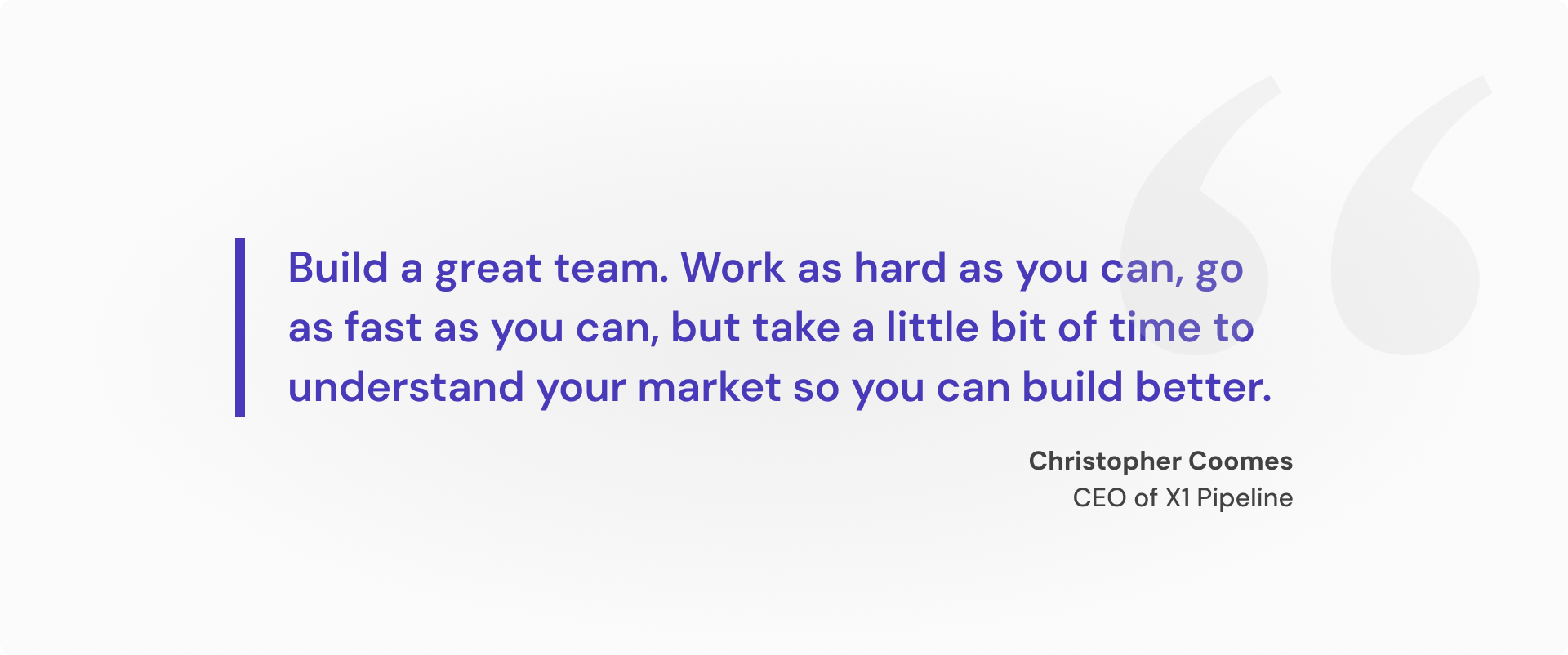
What Christopher advocates for is a synthesis — the best instincts of both cultures, combined deliberately. “Build a great team. Work as hard as you can, go as fast as you can, but take a little bit of time to understand your market so you can build better.”
Business 5.0: The End of Stale Data
There is a version of the future that Christopher calls Business 5.0.
The core problem he’s identifying is that everything goes out of date almost as soon as it’s created. A pitch deck submitted on Monday might be obsolete by Wednesday. A founder’s revenue figures, team composition, product roadmap, all of it shifts constantly.
“Anything you use now is instantly out of date,” Christopher says, “because startups move so fast.” He’s looked at enough pitch decks to know how often the gap between document and reality is significant. “I can’t tell you how many pitch decks I’ve looked at where it’s like, oh, this looks great, but they already pivoted. Or they’re out of business. Two months later they decided to quit, and I had no idea, because nothing’s updated.”
The Business 4.0 world (the era of platforms like Notion, HubSpot, and Excel) was built on static infrastructure. Tools designed for everyone, updated by hand, reflecting reality only when someone remembered to make them do so. Christopher compares it to “Wikipedia that never got updated,” versus a version that finds and refreshes its own information continuously. Business 5.0 is defined by real-time connectivity with dedicated platforms that update as companies evolve, so that what an investor sees today actually reflects what a company is today. “Everything is connected, everything stays current,” he says. “There’s no stale data.”
How Investors Will Evaluate Companies Differently
In a world where data is live and ecosystems are genuinely interconnected, the mechanics of investor evaluation shift in ways that go beyond convenience.
The first change is trust. When information is verifiable and connected to its source in real time, the question of whether to believe what a founder is telling you becomes less fraught. “If you say you’ve done something, it’s connected, so you know there are links that tie back to that information,” Christopher explains. Transparency becomes structural rather than something founders have to perform.
The second change is discovery. In the current model, investors find startups primarily through inbound applications and personal networks, both of which systematically favor founders who already have access. In a connected ecosystem, the logic inverts. “You don’t have to go find startups so much,” Christopher says. “They’re presented to you. They kind of just appear, because you’re in that ecosystem.”
What makes this more than a distribution story is the scale of personalization it enables. Christopher talks about “massive personalization at scale”: AI systems that understand an investor’s actual preferences well enough to surface a relevant South African startup that no one in a European network would have otherwise encountered. “If everything is connected and hyper-personalized,” he says, “somehow you’re going to get to that startup you never saw before and think — wow, that’s a great idea.” For founders in underserved markets, regions, or industries, that connectivity is the difference between being found and being invisible.
What Founders Should Do Right Now
For all the talk of future ecosystems and intelligent platforms, Christopher gives one advice: know what investors think about you before you ask them.
“Every single person you know is going to tell you your startup is awesome,” he says. “And it is not always true.” The people closest to a founder — friends, co-founders, early supporters — are the least likely to deliver the honest assessment. And by the time a founder walks into a room with a serious investor, it is far too late to hear that feedback for the first time.
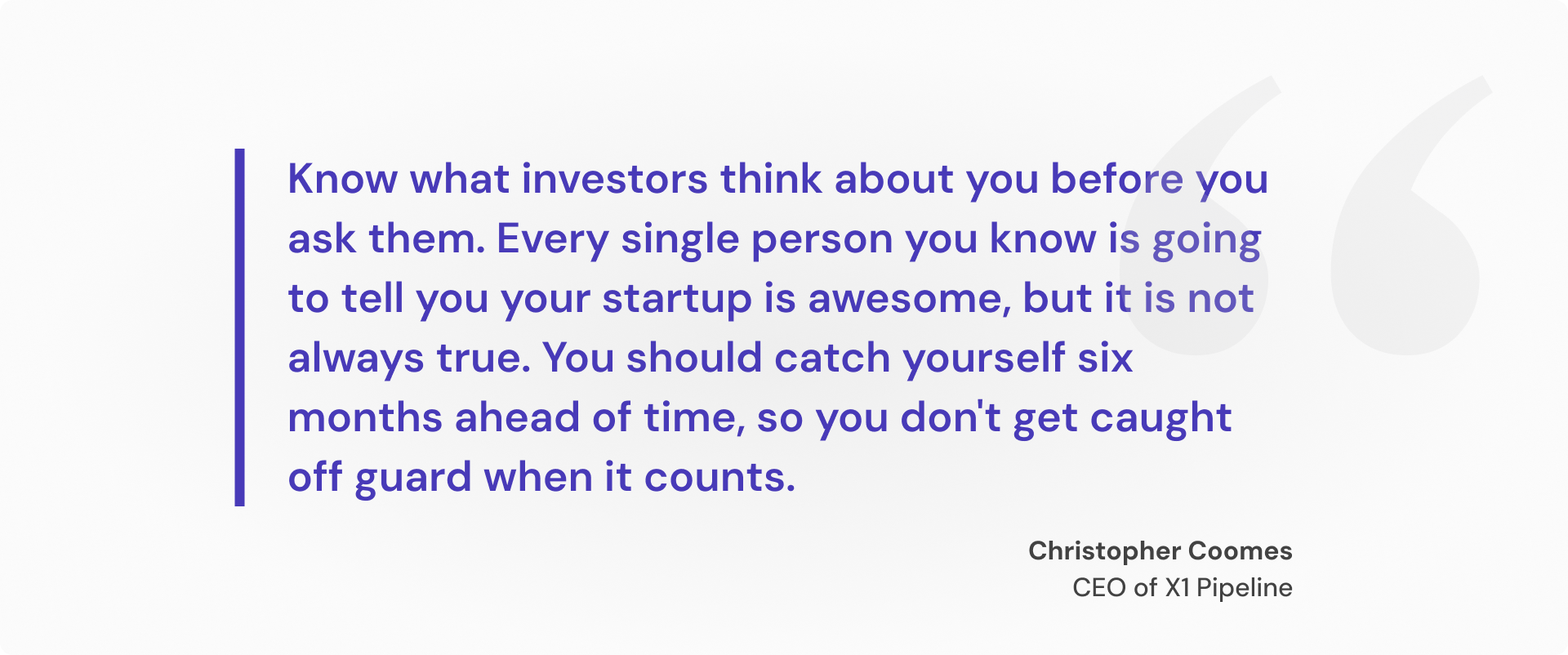
This is precisely what X1’s reporting tools are built to address. The platform surfaces the questions investors are likely to ask, identifies gaps in a startup’s positioning, and benchmarks the company against competitors, all before a founder has committed to a raise. “You should catch yourself six months ahead of time,” Coomes says. “So you don’t get caught off guard when it counts.”
Conclusion: A System Ready to Change
The through-line in everything Christopher Coomes describes, from the waste baked into today’s pitch process to the investability score to the promise of Business 5.0, is a refusal to accept that inefficiency is inevitable. The current fundraising system is not the result of anyone’s bad intentions. It evolved organically, layer by layer, until it became something that serves almost no one particularly well.
The founder in a market no one is watching, the investor drowning in decks that were never meant for them, the med-tech doctor who built something real but has no network to surface it — these are the people a better system would serve. Christopher Coomes is betting that the tools to build that system finally exist. And for the first time in a long time, it seems like he might be right.