
For many fintech startups, integrating Plaid is the first moment when technology, compliance, and user trust collide in a very real way. Until that point, most systems operate in a relatively controlled environment. Even if money is involved, it is often simulated, delayed, or abstracted away behind internal logic. Plaid removes that abstraction. The moment a user connects a real bank account, the product becomes part of a regulated financial data ecosystem.
This shift has consequences. Engineering decisions suddenly carry regulatory weight. Product decisions affect legal exposure. UX decisions directly influence user trust. And architectural shortcuts that once seemed harmless can become long-term liabilities.
INSART approaches Plaid integration with the assumption that this integration will define the future shape of the product. It is not treated as a feature, but as infrastructure. The objective is not simply to make Plaid work, but to make it work in a way that supports scale, withstands audits, enables future features, and protects the startup from its own early decisions.
This case study explains how INSART would approach Plaid integration for a mobile app, step by step, from early alignment through production hardening. The focus is on depth, correctness, and long-term sustainability.
Starting with product intent and regulatory reality
INSART never begins a Plaid project with code. We begin with intent. Specifically, we work with the client to articulate what Plaid data is meant to unlock in the product today and what it may unlock in the future.
This distinction matters more than it seems. Many startups integrate Plaid because it feels like a required step, not because the product logic truly demands it. As a result, they request broad access scopes, store more data than needed, and later struggle to explain why that data exists when auditors or partners ask.
During this phase, INSART helps the team map Plaid data to concrete user outcomes. Transactions might power budgeting insights, cashflow monitoring, alerts, or AI summaries. Account data might enable verification, onboarding, or payment flows. Each use case is examined critically, and anything that does not directly support a near-term feature is deferred.
This disciplined scoping has multiple benefits. It simplifies Plaid’s approval process. It reduces compliance risk. It lowers operational complexity. And it makes future audits easier because every data point has a documented purpose.
At the same time, we discuss regulatory expectations early. Even if a startup is not yet SOC 2 compliant or serving enterprise customers, the Plaid integration should assume that those requirements are coming. Designing with that future in mind avoids painful rewrites later.
Architecture as a deliberate trust boundary
Once intent is clear, INSART designs the architecture around a single guiding principle: sensitive financial data must be controlled centrally and transparently. This principle leads to a strict separation between the mobile application, the backend, and Plaid itself.
The mobile app is treated as an interface. It is responsible for initiating user consent and displaying results, but it is never allowed to become a data authority. All Plaid secrets, access tokens, ingestion logic, and transformations live exclusively on the backend.
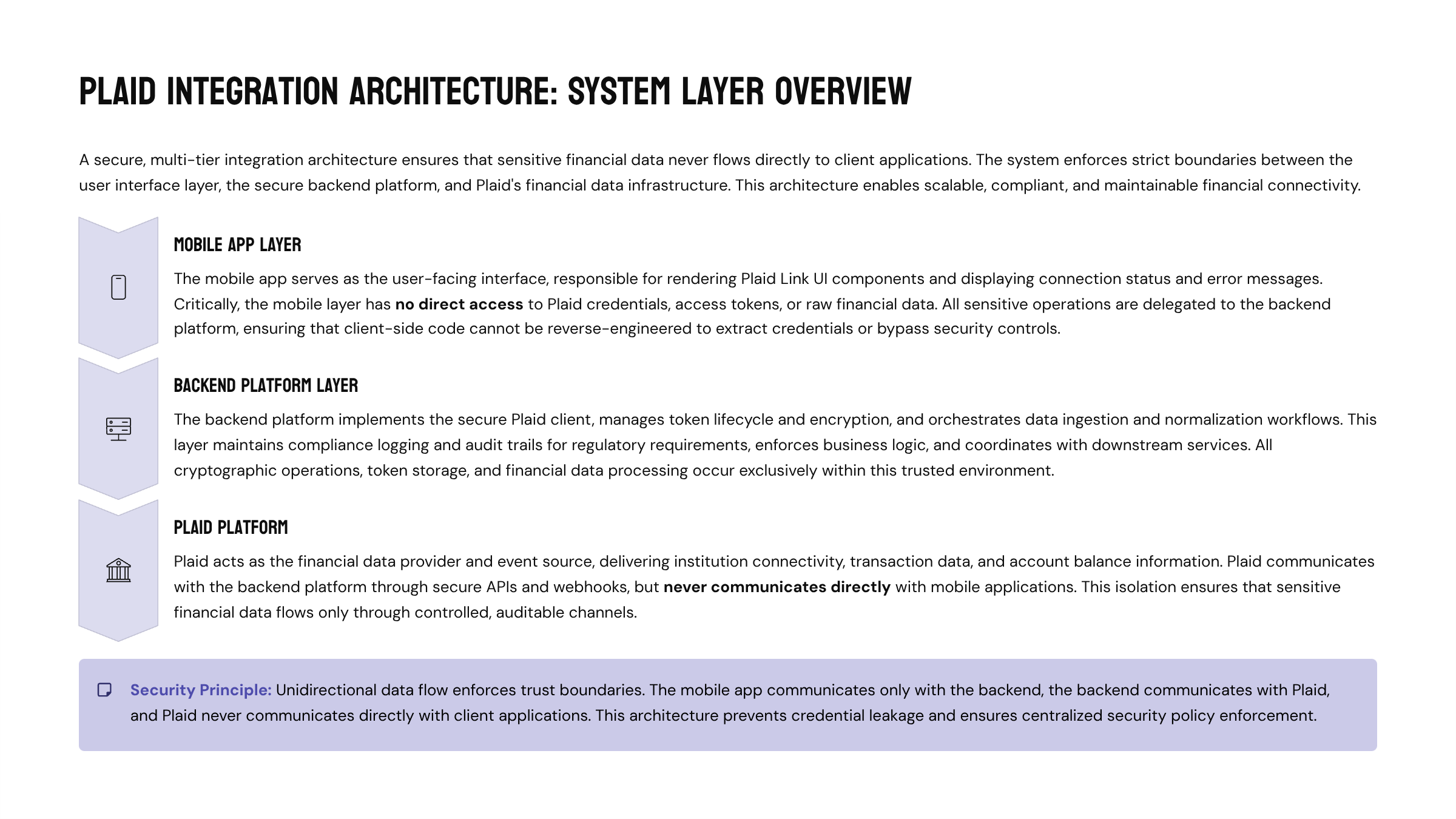
This separation is not just about security. It is about accountability. When something goes wrong, whether that is a failed sync, a user complaint, or an audit request, there must be a single place where the truth lives.
Diagram: conceptual system boundaries
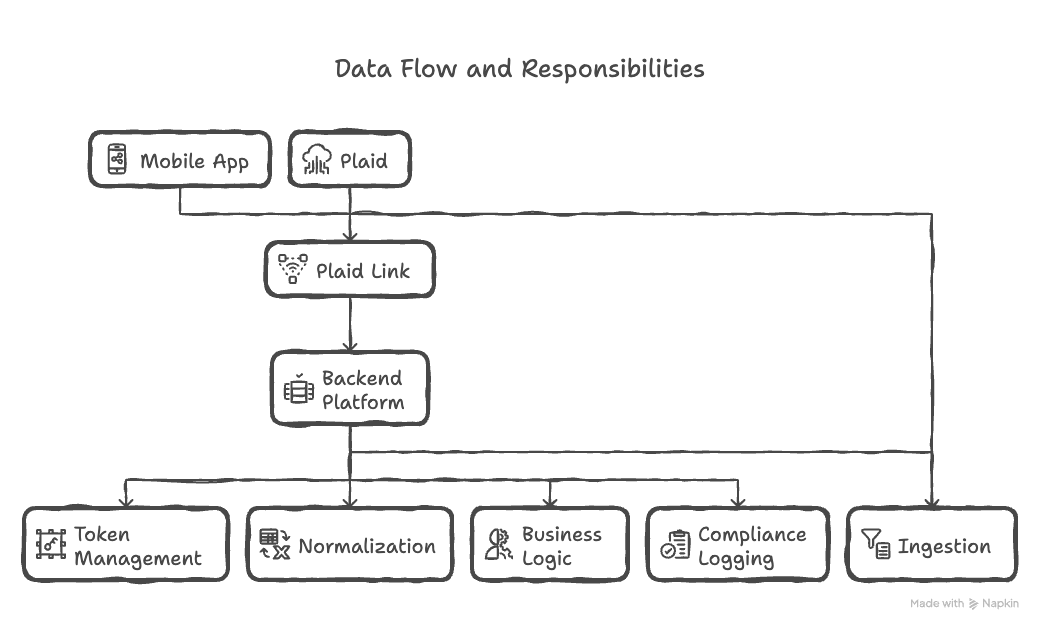
By drawing these boundaries early, INSART ensures that the system can evolve without breaking trust. Mobile apps can be updated independently. Backend logic can grow more sophisticated. Compliance controls can be added without redesigning the entire flow.
Designing the Plaid Link experience with user psychology in mind
From a user’s perspective, Plaid Link is one of the most sensitive moments in the product. It is the moment when the user is asked to trust the app with access to their financial life. Even minor confusion at this stage can create hesitation or abandonment.
INSART treats the Link flow as a product experience, not just a technical step. We pay attention to copy, loading states, cancellation handling, and recovery paths. The goal is to make the flow feel intentional, predictable, and respectful of the user’s time.
On the technical side, the mobile app requests a short-lived link token from the backend. That token defines exactly what the user is being asked to approve. The mobile app never holds long-lived credentials and never attempts to manage Plaid state.
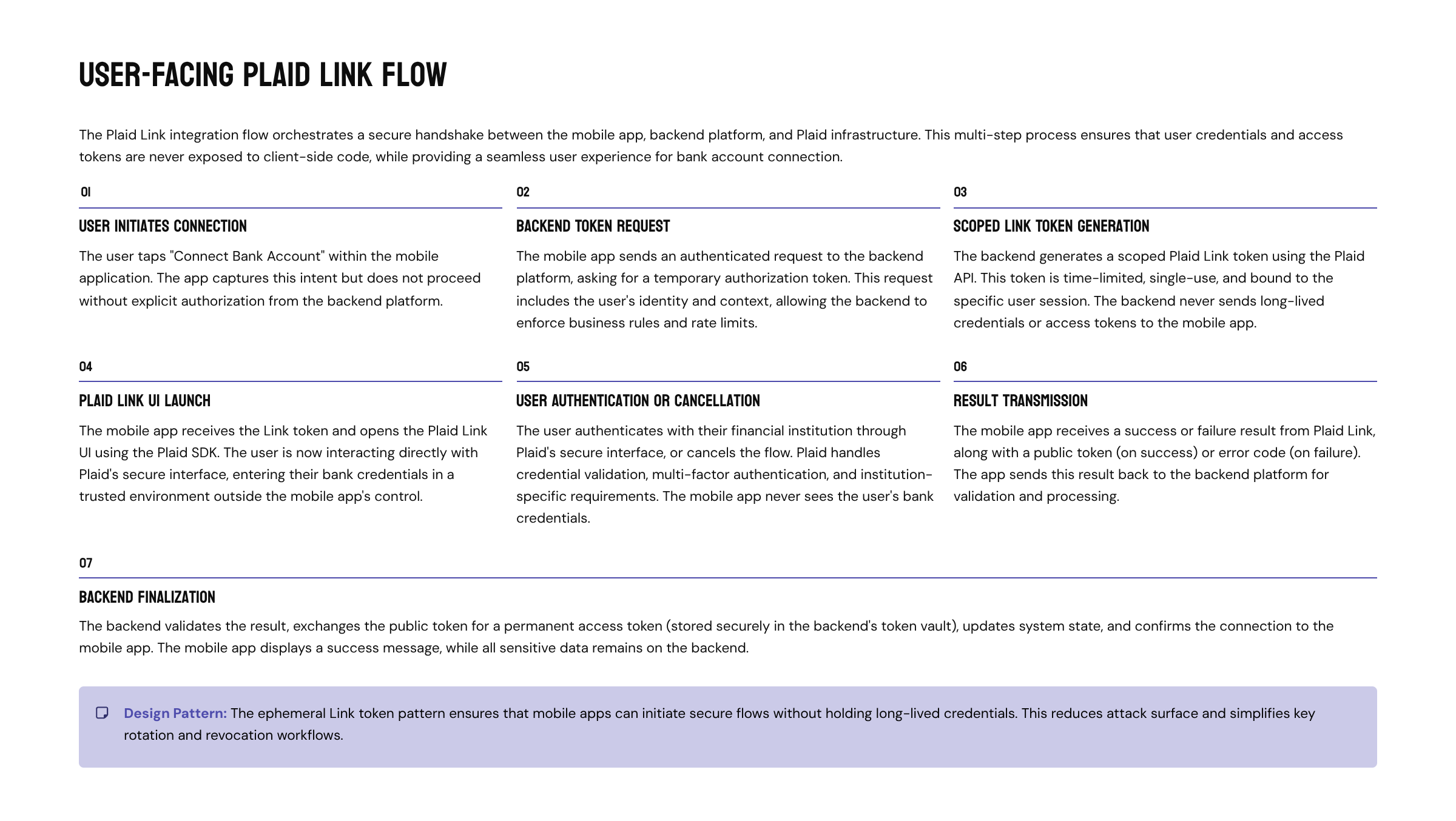
This simplicity is strategic. By keeping the mobile layer thin, INSART ensures that future changes to Plaid requirements, scopes, or reauthentication flows can be handled almost entirely on the backend. This reduces the need for emergency mobile releases and lowers operational risk.
Treating token exchange as a controlled system event
The exchange of a public token for an access token is the moment when the system crosses from user interaction into regulated data handling. INSART treats this exchange as a first-class system event, not a background detail.
This step is carefully logged, encrypted, and audited. Access tokens are never stored in plain text. They are never returned to the client. They are never logged. They are always associated with a specific user and institution.
Centralizing this logic also allows INSART to build future capabilities. Token revocation, reauthentication flows, institution-level monitoring, and usage analytics all depend on having a clean, consistent token management layer.
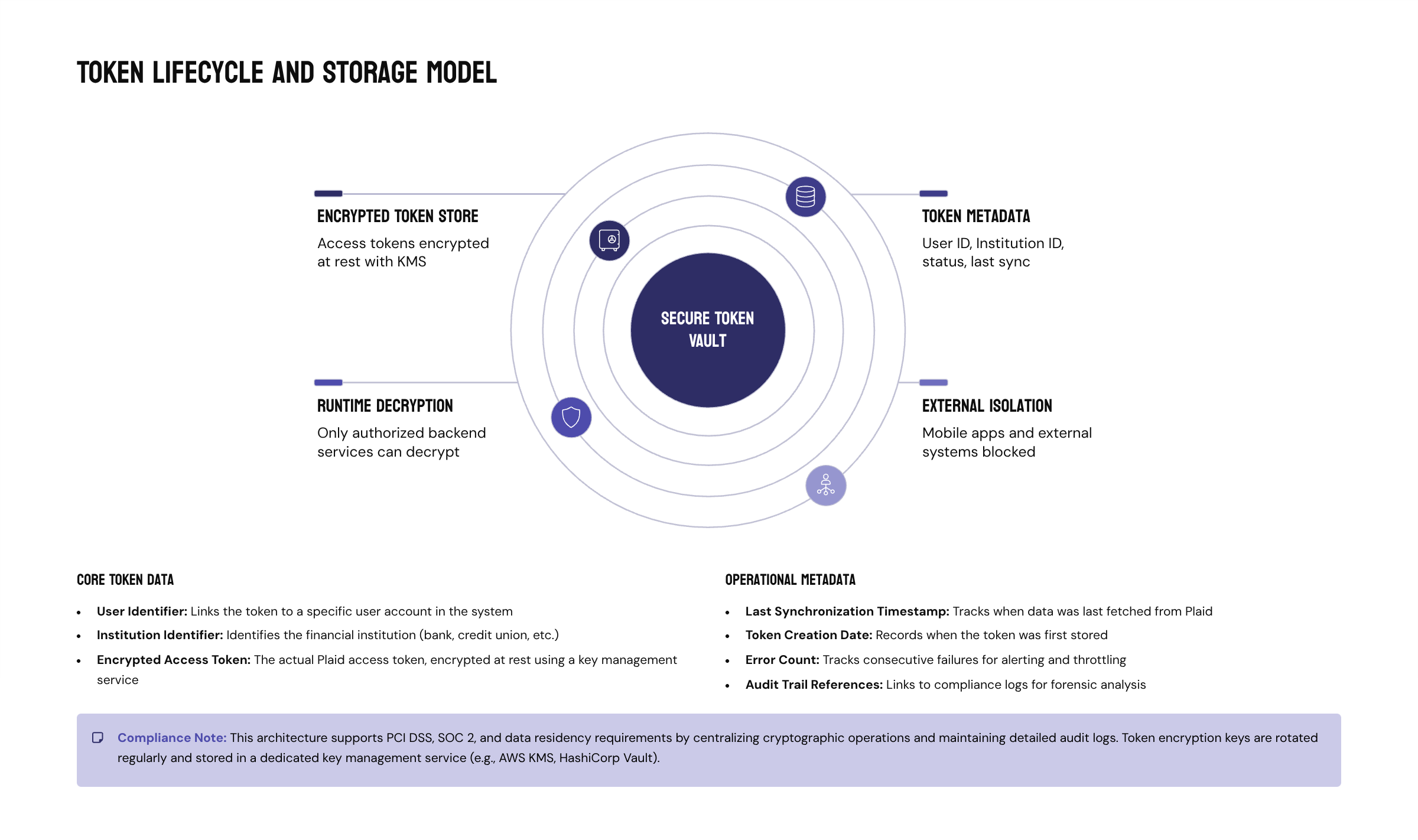
This approach may feel heavier than a quick prototype, but it pays dividends as the system grows. It reduces the risk of accidental leaks, simplifies incident response, and provides a clear audit trail.
Designing ingestion for reality, not ideal conditions
Financial data does not behave predictably. Transactions can appear days late. Pending transactions can change amounts. Institutions can go offline without warning. Users can invalidate credentials at any time.
INSART designs ingestion pipelines with the assumption that none of these events are rare. Instead of treating them as edge cases, we assume they are normal.
Webhooks are used as signals, not as authoritative data. When a webhook arrives, it triggers a controlled sync job. That job fetches data incrementally, reconciles changes, and updates the system state in a deterministic way.
Diagram: ingestion and reconciliation lifecycle
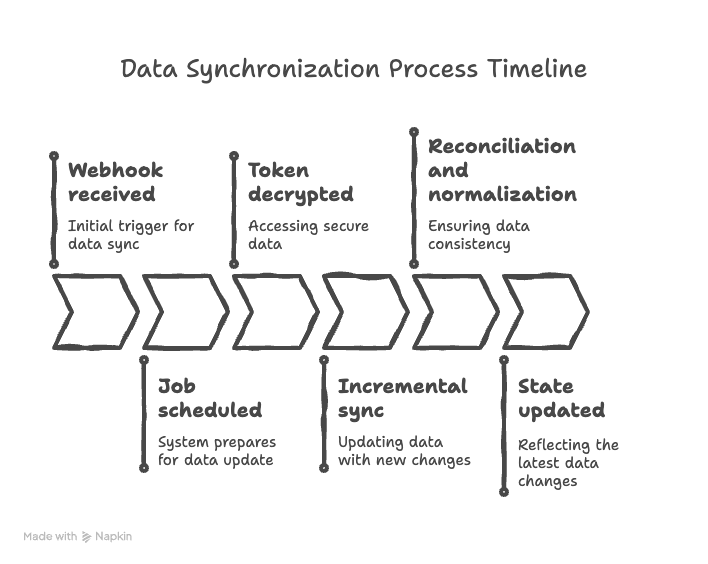
The incremental sync logic ensures that the system can recover from partial failures without manual intervention. If a job fails midway, it can be retried safely. If a webhook is delivered twice, idempotency guarantees consistency.
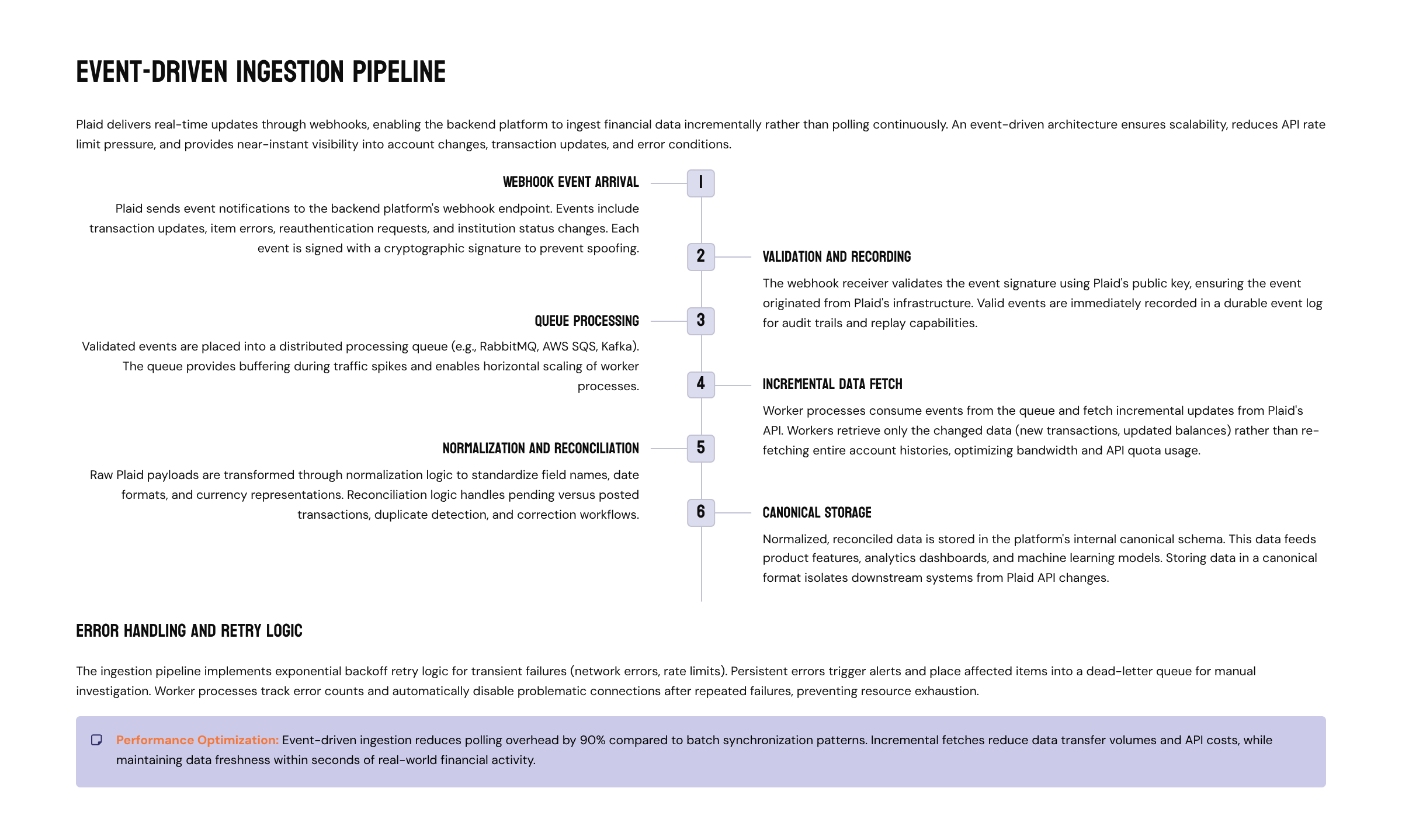
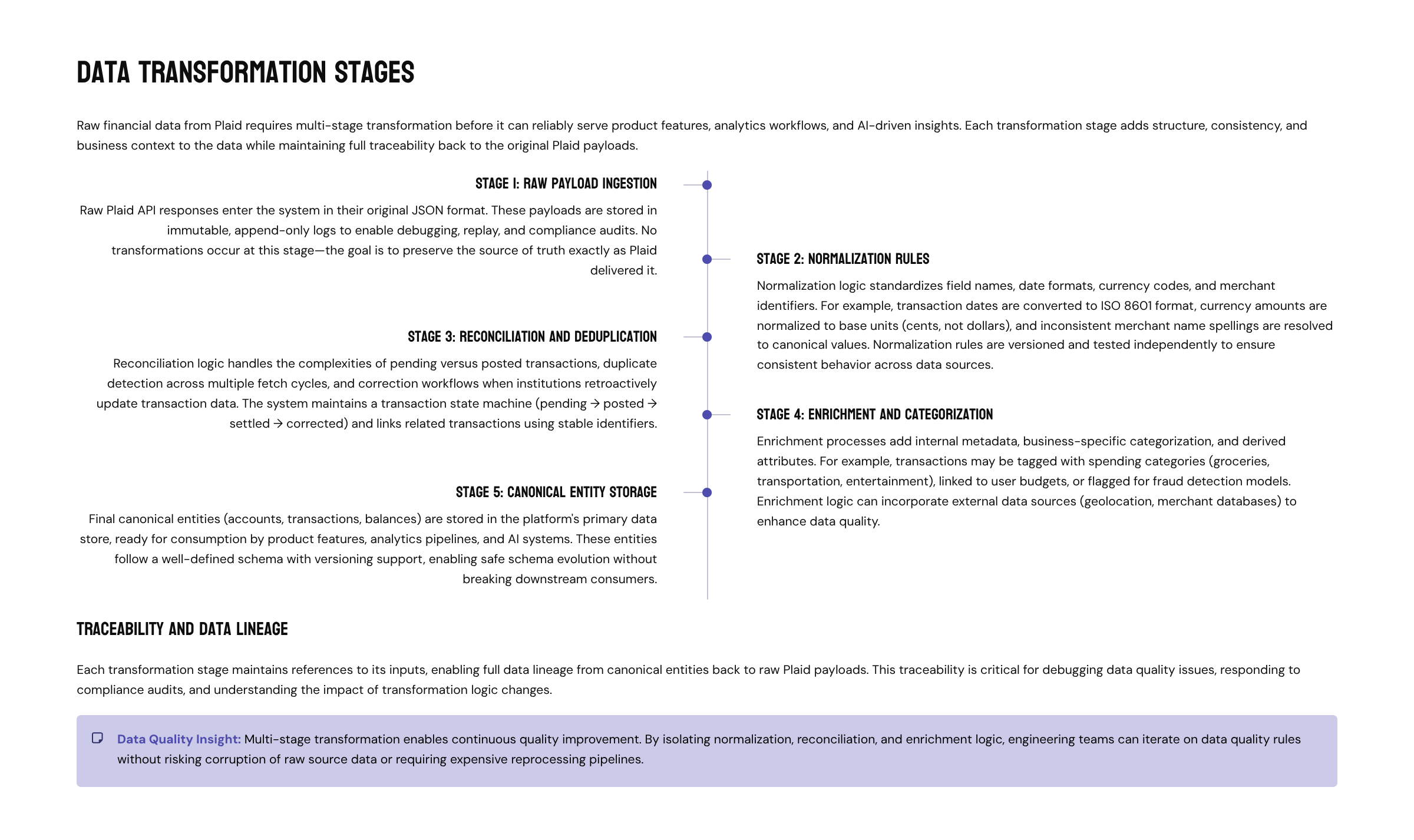
Transforming raw Plaid data into product-grade data
Raw Plaid data is designed to be comprehensive, not opinionated. That means it often contains ambiguity that products must resolve. INSART introduces a normalization layer that sits between Plaid and the rest of the product.
This layer creates a canonical representation of transactions and accounts. It resolves pending versus posted states, normalizes merchant naming, applies internal categorization rules, and prepares the data for downstream use.
Diagram: data evolution inside the system
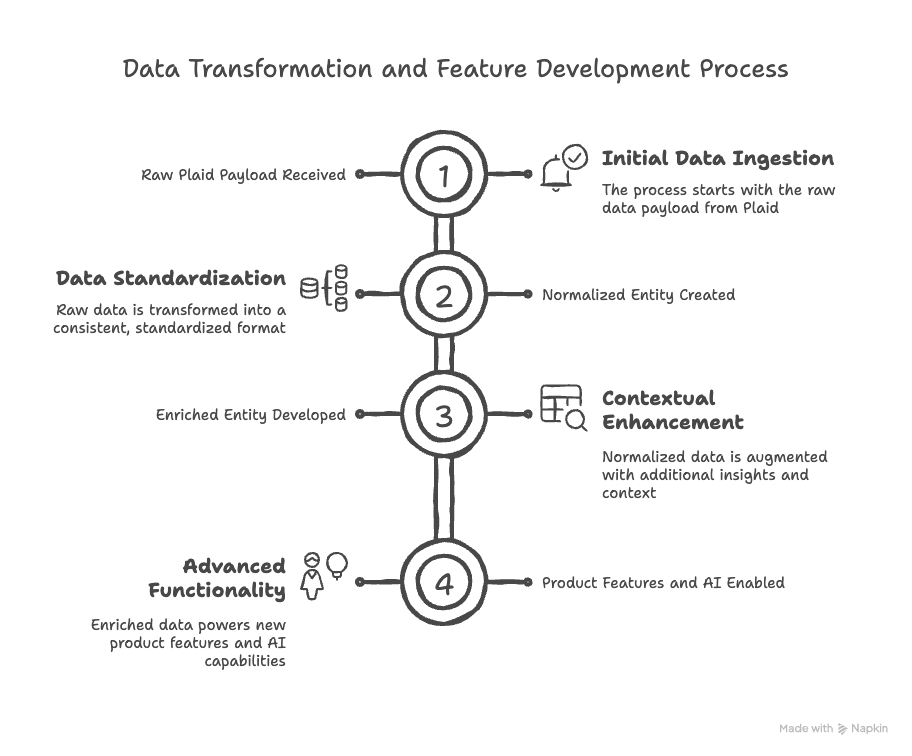
By separating raw ingestion from enrichment, INSART ensures that product logic is insulated from Plaid quirks. This also makes it easier to add AI features later, because the data feeding those models is consistent and predictable.
Embedding compliance into everyday system behavior
INSART does not treat compliance as a checklist. We treat it as a property of how the system behaves every day.
Access to financial data is logged. Permissions are explicit. User consent is recorded at the moment of action. Deletion requests propagate through all relevant systems. Tokens can be revoked instantly.
This design philosophy means that when compliance questions arise, the answers already exist in the system. There is no need to reconstruct history or explain undocumented behavior.
Designing failure paths that preserve trust
Failures are inevitable. What matters is how the system responds to them.
INSART maps Plaid errors into meaningful system states. A required reauthentication becomes a clear user prompt. An institution outage becomes a temporary status, not a broken app. Rate limits become retries, not user-facing errors.
This approach prevents frustration and reduces support burden. More importantly, it reinforces trust. Users feel informed, not confused.
Observability as a growth enabler
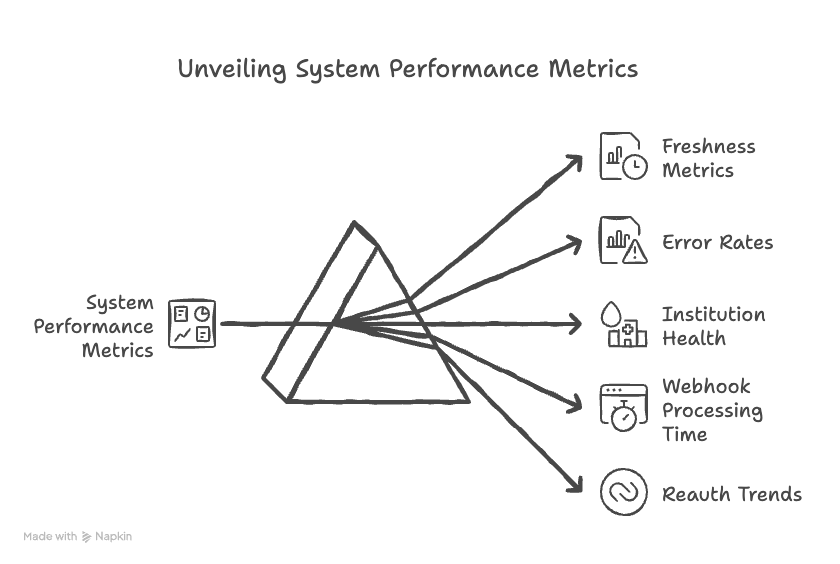
As the system scales, visibility becomes critical. INSART builds monitoring and logging into the Plaid integration from day one.
We track sync freshness, error distributions, institution reliability, webhook latency, and reauthentication frequency. This data informs product decisions, support priorities, and infrastructure planning.
Diagram: Plaid observability dashboard
Without this visibility, teams operate blind. With it, they can act decisively.
Why this approach matters when starting a Plaid partnership
A Plaid integration is not just a technical milestone. It is a statement about how seriously a startup treats trust, security, and scalability.
INSART’s approach ensures that this statement is a strong one. By investing in architecture, compliance, and data discipline early, startups avoid the painful rewrites and credibility gaps that often appear later.
For teams beginning a Plaid partnership, this methodology turns a complex integration into a stable foundation for growth, innovation, and long-term confidence.



![[SIGNALS] Banner for interview with Mark Beeston](https://insart.com/wp-content/uploads/2026/04/signals-banner-for-interview-with-mark-beeston-300x169.jpg "What It Takes to Raise in Fintech: Insights from Mark Beeston, Founder of Illuminate Financial")