
If 2021 rewarded speed and 2023 punished excess, 2025 is about discipline. The fintech market is still growing, capital is still flowing, and innovation hasn’t stopped. This yearbook is a grounded look at what actually changed across markets, engineering, funding, and execution, and what founders need to plan for if they want 2026 to work.
2025 Fintech Market in Recap
In 2025, the global fintech market hasn’t collapsed, and it hasn’t rebounded into another hype cycle either. It has settled into a more sober phase. Revenues now sit in the low hundreds of billions, growing at a steady mid-teens pace. Capital is still flowing, but far below peak levels. Regulation is no longer a distant risk. And the companies pulling ahead are no longer the loudest, but the most operationally prepared.
This is the context founders are planning into.
Growth Is Steady, but the Market No Longer Tolerates Inefficiency
The fintech market entering 2025 is neither contracting nor accelerating into another hype cycle. Global revenues sit in the $300–400B range, expanding at roughly 15–16% CAGR, with digital payments, embedded finance, and SME services continuing to anchor the market. North America remains the largest region by revenue, Europe follows, and Asia-Pacific is emerging as the fastest-growing geography as real-time rails and mobile-first financial services scale.
The demand side of fintech is not the problem. Structural tailwinds (smartphone penetration, cash displacement, open-banking APIs) are still firmly in place. What has changed is tolerance. Business models that leak margin, depend on heavy subsidies, or defer operational maturity are now exposed far earlier. Growth is available, but it must be earned through execution rather than narrative.
Capital Is Available, but Concentrated Around AI, Infrastructure, and B2B Economics
Funding has not recovered to 2021 levels, and it is unlikely to. Global fintech investment fell to roughly $95–100B in 2024, a seven-year low, with deal volumes down and the sharpest pullback at seed and early stages. Higher rates, geopolitical risk, and tighter LP expectations have reset how risk is priced.
Within that contraction, however, capital has become more selective rather than scarce. Investor interest has clustered around AI-enabled fintech, financial infrastructure, and B2B platforms. The share of fintech rounds involving AI has nearly tripled since 2021–22, with particular momentum in financial data, digital lending, banking technology, and insurtech. Late-stage capital is thinner but still accessible to scaled players that can demonstrate credible paths to profitability, while M&A activity continues as incumbents acquire payments, regtech, and embedded-finance capabilities rather than building them in-house. In short, funding in 2025 rewards focus, defensible economics, and technical depth, not surface-level growth.
Regulation Has Become a Core Design Constraint, Not a Compliance Afterthought
The most decisive shift shaping fintech in 2025 is regulatory. In the EU alone, multiple frameworks move from abstract risk to operational reality. DORA, effective from January 2025, imposes strict requirements around ICT risk management, incident reporting, and third-party resilience. MiCA begins to materially shape crypto-asset service providers. PSD3 and the Payment Services Regulation (PSR) tighten authorization, SCA, and access to payment systems, while effectively phasing out the legacy distinction between e-money and payment institutions.
Layered on top, the EU AI Act introduces governance, explainability, and human-oversight obligations for high-risk financial AI use cases. For fintechs, this means architectural decisions around fraud detection, underwriting, and automation now carry regulatory weight from day one. UK and EU payments reforms further emphasize consumer protection, fraud reimbursement, data access, and operational resilience.
Tech Trends Founders Must Understand
As fintech enters a more disciplined, margin-driven phase, technology choices are either becoming strategic constraints or accelerators. Below, you’ll see the shifts that will shape how fintechs build, operate, and compete over the next cycle.
The Rise of Physical AI
For most of the last decade, “AI” in fintech meant software: models scoring risk, detecting fraud, personalizing flows, or automating back-office decisions. Physical AI marks a different shift, where intelligence moves out of dashboards and into the real world.
What do we mean by physical AI? It’s all AI systems embedded in machines that can perceive their environment, make decisions, and act autonomously. Not generate text. Not optimize a funnel. Actually move, handle objects, interact with people, and operate in imperfect physical conditions. Technically, this is powered by multimodal models (vision–language–action), simulation, and learning systems that allow robots to adapt rather than follow fixed scripts.
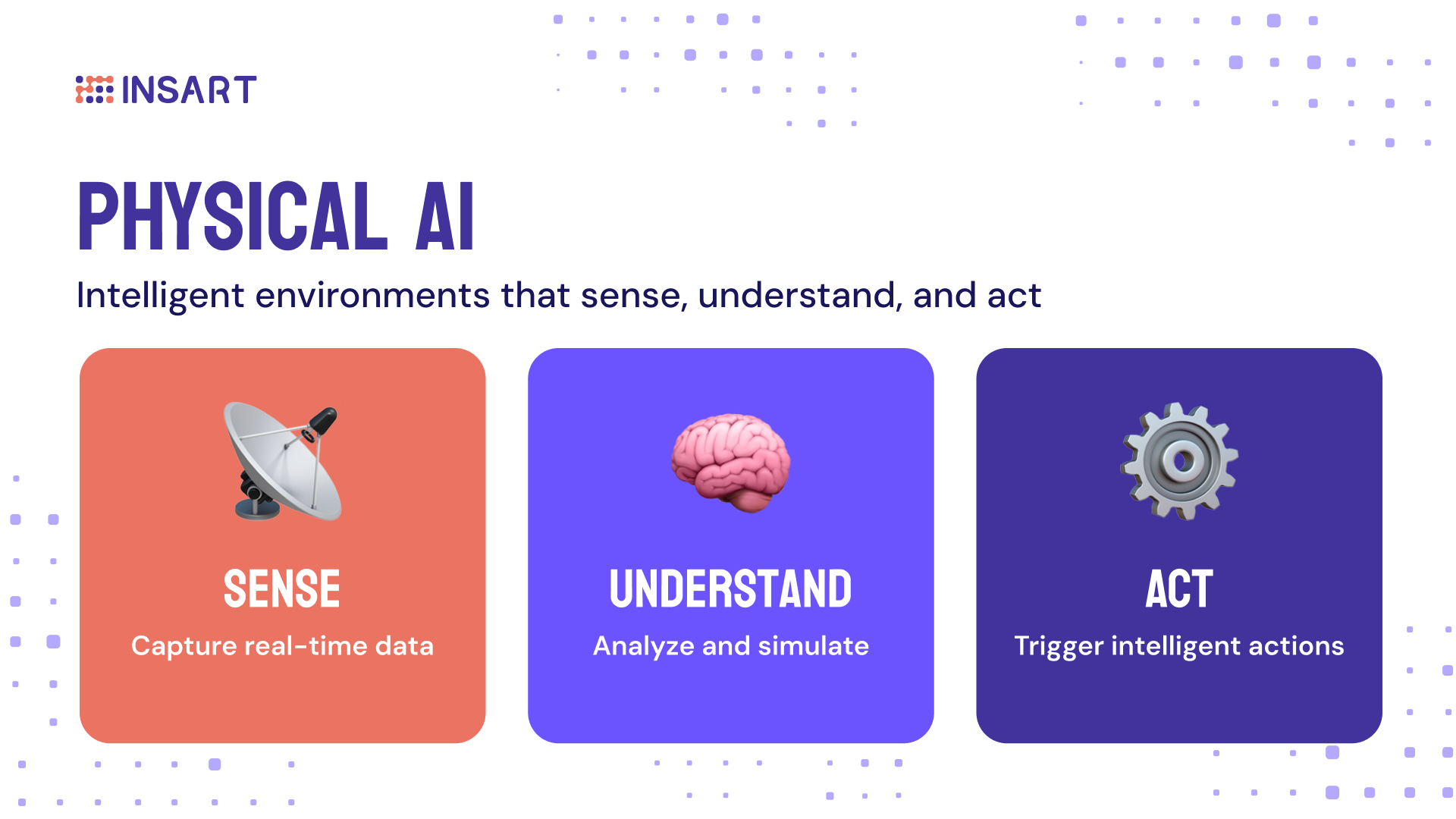
Why do fintech founders need to understand this trend? It’s not robotics itself, but the economics it fundamentally alters. Physical AI lowers the marginal cost of routine, location-bound operations: branch interactions, cash handling, identity checks, logistics, inspection, and service delivery. Analysts already track a growing “banking robot” market (branch greeters, service kiosks, cash automation) estimated at roughly $1.5B in 2024, growing steadily toward the end of the decade. The deeper signal is that automation is no longer confined to digital workflows. It is becoming embodied, and that changes cost curves, service models, and where value accrues.
That shift is no longer speculative. SoftBank’s $5.4B acquisition of ABB’s Robotics division makes it explicit. On the surface, it looks like a large industrial deal. Strategically, it’s a statement about where the next AI platform layer will live.
ABB brings industrial-scale robotics, customers, and deployment experience. SoftBank brings capital, compute, model infrastructure, and a portfolio already spanning AI chips, data centers, and foundation models. Together, the bet is not on single-purpose robots, but on general-purpose, adaptable machines powered by “world models”: physical systems that can be trained in simulation and redeployed across tasks via software updates. The same logic that turned cloud providers into strategic chokepoints is now being applied to physical operations. As labor shortages grow and compliance, security, and service costs rise, automation that spans both digital and physical processes becomes a competitive lever.
Physical AI won’t replace fintech software. But it will increasingly define where fintech services are delivered, how cheaply they can scale, and which platforms capture the upside when intelligence stops living purely in code and starts operating in the real world.
AI needing memory
AI systems heading into 2025 are running into a fundamental limitation: intelligence without memory doesn’t compound. Bigger context windows help, but they don’t solve the core problem. Models that can’t reliably remember past interactions, user state, or learned facts tend to behave inconsistently.
That’s why a visible shift is underway in how teams design AI architecture. Instead of pushing everything into prompts, builders are treating infrastructure like Redis and Featureform as an external memory layer for agents and models. The goal is to give systems the ability to recall, plan, and adapt across sessions rather than respond as if every interaction were the first.
Architecturally, this shows up in a move toward multi-layer memory. Short-term context still lives in the model window. Episodic memory (conversations, events, embeddings) is pushed into fast external stores. Long-term, structured knowledge lives elsewhere, governed and reusable across training and production. In this setup, databases and feature stores stop being passive storage and start functioning as active memory systems.
Redis is a clear example of this reframing. Long known as a high-performance key-value store, it is increasingly positioned as real-time AI memory. Recent updates, including native vector types and support for similarity search, reflect generative and agentic workloads that require low-latency recall of embeddings, conversation state, and behavioral signals. In production environments where milliseconds matter, in-memory systems like Redis are becoming the default choice for operational AI memory rather than just caching.
At a different layer, tools like Featureform point to the same shift from another angle. Feature stores were originally sold as ML hygiene: consistency, versioning, point-in-time correctness. But in practice, they act as shared, governed memory for models. Features representing user behavior, risk signals, or content metadata become durable knowledge that multiple models and agents can rely on without rebuilding their own ad-hoc state. This is especially critical as organizations move from single models to fleets of agents operating across products.
Put together, Redis and Featureform illustrate a broader 2025 pattern: memory is becoming a first-class architectural concern in AI systems.
AI/ML, cloud-native, data-rich systems
AI-first, cloud-native, data-rich architectures are shifting towards becoming the baseline for staying competitive. As the market tightens, these stacks have become the only viable way to deliver strong user experience, manage risk and regulation in real time, and meet the profitability and scalability thresholds that both investors and supervisors now expect. Across industry analyses, the fintechs pulling ahead are not the ones shipping the most features, but the ones rebuilt around modern data pipelines and AI embedded deep into their core systems.
The economics explain why. AI only compounds when it runs on high-quality, continuously learning data. Leaders are using ML across underwriting, fraud, pricing, servicing, and growth (not as bolt-ons, but as end-to-end decision engines). This is where margins improve: better risk selection, more precise personalization, and faster feedback loops. Without data-rich systems feeding these models, products stay generic and losses stay stubbornly high.
Cloud-native infrastructure is what makes this viable at scale. Modern fintech stacks increasingly treat the cloud not as hosting, but as a unified data and AI platform, blending real-time analytics, ML training, and low-latency serving. This enables elastic scaling during peak demand, faster iteration cycles, and seamless API-based integration with partners and BaaS ecosystems. Patterns like streaming fraud detection, real-time credit decisions, and adaptive personalization simply don’t work on legacy architectures.
The same foundation now underpins compliance and resilience. As regulatory expectations rise around explainability, monitoring, and model governance, fintechs are being pushed toward auditable, data-driven systems with clear lineage and continuous oversight. In a heavier regulatory cycle, AI plus cloud-native data platforms are framed as cost control — the only way to automate compliance at scale without breaking unit economics.
Taken together, the signal for 2025 tells that AI/ML, cloud-native, and data-rich systems are the operating system for fintechs that want to compete on experience, survive regulatory pressure, and grow profitably in a more disciplined market.
The Founder Execution Gap in 2025
In 2025, most fintech failures are no longer about a lack of vision. Founders generally see the opportunity. The gap appears later — in execution. Early-stage teams consistently overestimate how far a good idea and a polished demo can carry them, and underestimate how slow, cross-functional, and operationally heavy it is to turn a regulated financial product into a real business. What breaks teams is not ambition, but misjudging the grind (distribution, regulation, risk, infrastructure, and team design) all at once.
Building Around a Problem, Not a Product (and Not AI)
A recurring pattern in fintech post-mortems is teams building around a compelling technology (increasingly AI) without anchoring it to a specific, monetisable pain for a clearly defined customer. Despite strong engineering and UX, “no market need” or “misaligned with customer” remains one of the top reasons fintechs fail.
Financial services magnify this mistake, as switching costs, KYC, onboarding, and perceived risk are far higher than in general SaaS. The assumption that “if we build it, they will come” rarely survives first contact with users or buyers. The fintechs that scale tend to start with a painfully narrow wedge problem, earn trust and distribution, and only then expand. Most early teams try to jump straight to a “platform” before they’ve earned the right.
Treating Regulation as a Side Quest
Many early-stage founders still assume regulation can be outsourced to a BaaS partner or addressed later. In practice, a large share of fintech failures in 2025 are tied to preventable compliance issues: weak AML controls, mis-licensing, poor data protection, or inadequate governance.
The execution gap here is misunderstanding the slope. Moving from prototype to something a bank, scheme, or regulator will approve requires far more than API integration. It demands policies, monitoring, audit-ready data, and second-line functions embedded into how the product is built and run. Teams that succeed design for compliance, risk, and resilience from day one.
Misreading Distribution and Go-To-Market in a Crowded Field
Distribution is another place where optimism collides with reality. Many founders underestimate how hard it is to win customers when incumbents and first-wave fintechs already cover most obvious use cases. Case studies repeatedly show overreliance on inbound demand or “virality,” assuming that a well-designed product and competitive pricing will self-distribute.
Execution gaps typically show up as vague ICPs, feature-rich but unbuyable products, and no realistic channel strategy, whether banks, ISVs, marketplaces, or brokers. Underinvestment in sales, partnerships, and customer success is common, especially compared to engineering spend. By contrast, scaled winners focus capital on a narrow set of proven channels, lock in unit economics, and only then expand.
Overbuilding Features, Underbuilding Infrastructure and Operations
Finally, many teams misjudge the balance between visible product velocity and invisible platform maturity. They overbuild features and underinvest in the boring but decisive layers: data, observability, operations, and resilience. Failed initiatives often point to three recurring root causes: architectural complexity, over-engineered AI in v1, and heavy dependence on third-party vendors without redundancy or exit plans.
The execution gap we’re talking about includes fragmented data models, analytics and risk run off exports instead of production pipelines, manual handling of chargebacks and fraud, and rising infra costs no one owns at the board level. The fintechs that pull ahead invest early in data and ML pipelines, cloud-native infrastructure, and operational processes that scale, lowering marginal cost while making partners and regulators more comfortable.
2026 Outlook for Early-Stage Fintech Innovators
If the execution gap defines where most fintechs fail, the outlook for early-stage founders in 2025 clarifies where the bar now sits. The market is tougher, yes, but it’s also cleaner. Capital is more selective, shortcuts are gone, and the expectations are explicit. For teams that execute with discipline, the opportunity set is arguably better than it’s been in years.
A Higher Bar for Funding, but Clearer Signals
Funding has stabilized, but it hasn’t relaxed. Capital is flowing into fewer, higher-quality deals, with smaller early-stage cheques and tighter milestones. Founders are expected to show focus, capital efficiency, and credible paths to profitability much earlier, especially around regulation, data, and unit economics. The era of “fund the story first” is over.
Where New Companies Still Break Through
The opportunity set has shifted. Investor and operator attention is clustering around AI-native, infrastructure-heavy, B2B and B2B2X models embedded into existing platforms. Real-time payments, orchestration layers, regtech, risk infrastructure, and AI-driven productivity continue to show the most whitespace. Less consumer novelty, more operational leverage.
Regulation and Infrastructure as Demand Drivers
A heavier regulatory cycle raises the cost of entry, but it also creates demand. Tools that help banks, PSPs, and platforms manage compliance, resilience, and AI governance are becoming easier to sell, not harder. Early-stage teams that design for data lineage, auditability, and operational resilience from day one are structurally better positioned to partner, distribute, and scale.
INSART Framework: Planning the Next 12 Months
The INSART framework for the next 12 months is deliberately simple. It’s designed to reduce false certainty early, surface risk before it compounds, and force real decisions at the moments that matter. Instead of treating MVP, GTM, and advisory as separate initiatives, we treat them as three overlapping tracks that run throughout the year: Discovery and MVP, GTM and learning loops, and Advisory as governance.
The point is to time-box uncertainty, tie each phase to concrete outcomes, and use advisory input as a forcing function. When these tracks stay aligned, teams learn faster, build less waste, and enter 2025 planning with clarity instead of momentum theater. Think in four 3-month blocks, each dominated by a different question:
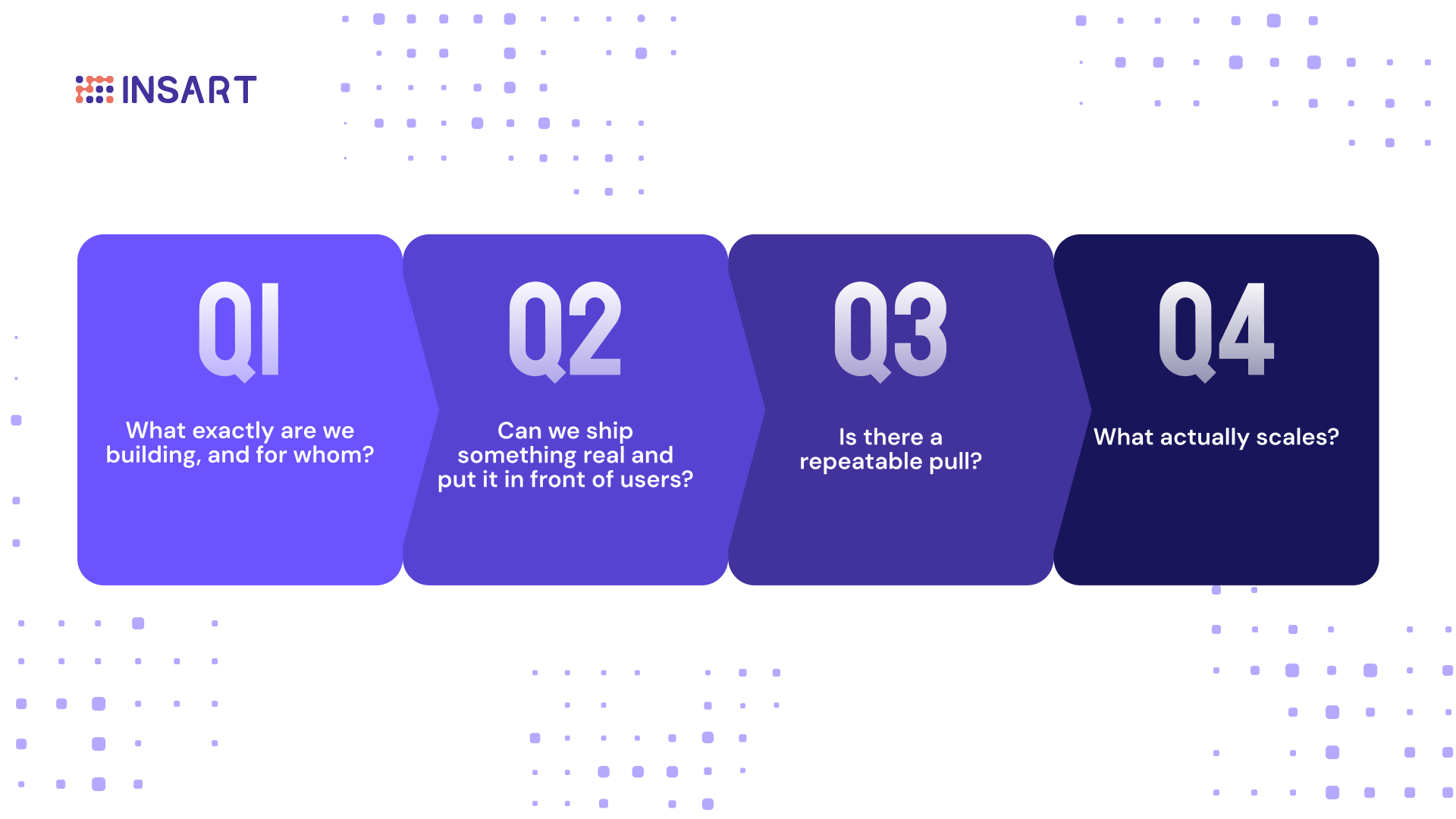
Discovery Before Commitment (Months 0–2)
Before committing serious build time, run a structured discovery phase. The output here should be artefacts: a clear ICP, defined jobs-to-be-done, prioritised features, a first-pass data model, and success metrics you can defend.
Use low-fidelity tests to validate demand (interviews, clickable prototypes, fake-door pages, even manual concierge flows). The win condition here is a written bet: who you serve, what problem you solve, and what you are explicitly not building in year one.
MVP as a Learning Instrument (Months 2–6)
The MVP should be aggressively narrow: one segment, one core workflow, one pricing shape. Protect scope with a prioritisation framework and tie features to explicit hypotheses you can test within 30–60 days of launch.
Crucially, “done” doesn’t mean shipped UI. It means basic observability, data capture, and support processes are in place so you can actually learn. An MVP that can’t tell you what users do and why is just a prototype with hosting costs.
GTM and Learning Loops (Months 3–12)
GTM shouldn’t wait for “perfect.” Run 90-day GTM loops in parallel with build: ICP lists, messaging, offers, channels, and weekly metrics reviews. Treat each loop as an experiment in distribution — self-serve vs sales-led, direct vs partner, pricing that clears vs pricing that flatters.
By months 6–12, the question shifts from “does anyone care?” to “what’s repeatable?” This is where onboarding, activation, and support get sharpened, and where you decide whether you’re ready to raise, or need another cycle of proof.
Advisory as Governance
Advisors are most useful when they’re part of the operating system, not a quarterly pep talk. Keep the group small, define clear domains (product, GTM, risk/reg), and attach advisory sessions to real milestones: post-discovery, pre-launch, post-MVP, pre-raise.
Use advisors to pressure-test two things relentlessly:
(1) whether discovery insights actually show up in the roadmap, and
(2) whether product and GTM decisions align with regulatory, data, and capital constraints.
Done right, this turns the next 12 months from a blur of activity into a sequence of explicit bets.
f you’re planning the next 12 months and want to pressure-test your assumptions before they harden into architecture, roadmap, or burn, we use the same framework outlined above to help founders gain clarity.